Saturday, August 17, 2013

Durham Cannonball Drama (Part 2)


Last week I posted about a Civil War cannonball, recently recovered by a Durham homeowner, which was destroyed by the city's bomb squad.  I ended by mentioning that it’s possible that what was found and destroyed wasn’t even a cannonball at all!  This may seem like a bold claim, but there are some discrepancies in the news stories that I will point out below to support this hypothesis.

First, let’s talk about the probability that it is the real deal.  As regular readers of this blog probably know, more than 100,000 soldiers fought, marched, and camped in central North Carolina at the end of the war in 1865.  Bennett Place, the site of the largest surrender of Confederate troops during the war, is just a few miles from where the cannonball was found.  It’s certainly not out of the question that a cannonball could be found in the area.  On the other hand, there have been many millions of similar sized iron balls created in the United States that have absolutely no relation to artillery projectiles.  The most common non-cannonball use for these iron spheres would be mill balls, used in a large rotating cylinder to crush and grind material such as raw ore.  Other uses of large iron spheres include fence fixtures, steam engine governors, shot-puts, and crane counter-weight balls to name a few.  Many even have threaded holes (such as filled shot-puts) that can resemble fuse holes in an exploding shell.

(Left)  While they bear a resemblance to solid shot cannonballs, these are steel mill balls used for grinding in cement mills.  (Right) Iron balls are used in a centrifugal force governor to control the speed of a steam engine.  Photo credit here.

Identifying the fuse in the cannonball would be able to identify it as ordinance definitively.  Unfortunately, while several articles on the Durham cannonball mention a fuse, there are no images of the ball before detonation and no mention of the recovering the fuse afterwards.  Without a fuse, the next best way to ID a cannonball would be extremely accurate measurements of the ball’s diameter and weight.  Manufactured ordinance had to meet very exact size standards in order to enter and be fired from the cannon’s barrel safely.  If an iron ball deviates from the measurements in the known ordinance shot tables, it is incredibly unlikely that it was ever intended as a cannonball.  Once again, though, the diameter of the Durham ball isn’t listed in any of the articles I have seen.

Next we’ll look at the weight of the ball.  The Durham bomb squad reported that the shell was a “6 pounder Bormann fused ball".  While the Herald Sun reports that the name refers to the weight of the powder charge, this is incorrect.  The “6 pound” refers to the weight of a solid cast iron cannonball of the diameter used in that gun.  A fused cannonball is not solid, however, and includes a hollowed out cavity filled with lead or iron balls, gunpowder, and a packing matrix.  According to the Ridgeway Reference Archive, a fused 6 pounder ball typically weighs between 4 and 5 pounds.  The Durham bomb squad reported that the recovered ball weighed “about 6 pounds”, but that reported weight is inconsistent with a cannonball with a fuse.  This could be a misstatement by police or a misinterpretation by reporters, but without a more accurate measurement of the cannonball’s weight prior to detonation, we can’t use this method for ID either.

This is a cross-section of the so-called "cannonball" detonated by the Durham bomb squad last month.  The photograph is from the Durham Sheriff's Department via the News and Observer.

What we do have, however, is a cross section of the ball after the controlled detonation.  We can see here a cylindrical hole running through an otherwise solid ball.  Compare this to the cross-section of an authentic Bormann fused 6 pound ball below.  The central “hole” in the Durham ball bears no resemblance to the spherical powder chamber of an authentic 6 pounder shell.  Neither opening in the Durham ball matches with the distinct cross-section of the Bormann fuse hole.  The differences are striking.  Artillery expert Peter George, who has disarmed shells for the National Parks Service and literally wrote the book on Civil War artillery, had this to say:  “Absolutely no cannonballs had a tunnel going all the way through the iron body.”

Now this is the cross-section of a 6-pounder Bormann fused ball.  Note the significant differences from Durham "cannonball" above.  Photo from the Ridgeway Reference Archive.

I’m not an expert, and wouldn’t claim to be, but it appears to me that what was presented as the Durham “cannonball” probably isn’t.  Or, at the very least, there are a few too many discrepancies and unanswered questions for my liking.  Sadly, we will probably never know the answer – the Durham police didn’t return the fragments of the “cannonball” to their finder.  the truth behind this mystery appears to have gone up in smoke!

Until next time, thanks for reading, and God Bless!

Friday, August 9, 2013

Durham Cannonball Drama (Part 1)

Hey everyone!  First of all, let me apologize for being slow on posting.  This summer in NC has been hot, wet, and extremely busy with personal and professional obligations.  Crops are in fields and the woods are overgrown, so it's been tough to get out much.  I'm looking forward to the fall for sure!  Okay, now on to the good stuff.

Several readers have sent me local news articles about a cannonball recently unearthed by a homeowner doing yard work on his property on Main Street in Durham.  The story goes that the owner, Michael Jacobs, tried to sell the artillery projectile to an antique dealer, who informed him that the potentially live ordinance was dangerous and refused to touch it.  Jacobs then called the Durham police, who used a controlled detonation to destroy the intact cannonball, splitting it in two.

The Durham cannonball, image from WRAL

The problems I have with this story are twofold.  First, I’d like to address the unnecessary destruction of this Civil War ordinance.  Post war artillery, including WWI and WWII artillery, can be extremely sensitive to handling when discovered after many years in the ground.  I would never recommend handling them in any way, and call authorities immediately!  Civil War ordinance, on the other hand, is generally much more stable.  I have watched live Civil War shells being excavated in person, and held them in my own hands.  While I have recovered solid shot artillery in the past (which contains no powder charge), I hope that someday I do find a complete shell!

Live ordinance dug at the RRRHA Mine Run Hunt.

So are CW shells completely safe to handle?  In some cases the black powder inside the shell can still be very much alive.  In others, water seeping inside the shell can cause a breakdown of the powder into hydrogen sulfide and hydrogen gas, which are also explosive.  So make no mistake about it – while simple handling isn’t going to set it off, it’s still a bomb.  Even though you'd have to be doing something incredibly stupid to make it go off (like subjecting it to high heat or trying to drill into it yourself), it should still be disarmed as soon as possible.

The Durham police chose to “disarm” the bomb by blowing it up.  While I appreciate that they were acting out of an abundance of caution, I do think it’s a shame to needlessly damage an object of such historical relevance when other options are available.  Many CW shells had paper or wood fuses which have rotted out long ago, exposing the powder chamber.  Disarming is as simple as flushing the powder chamber thoroughly with water.  For solid fused shells, the shell can still be disarmed by a trained professional with the right experience and equipment.  This will require drilling into the powder chamber, which can be EXTREMELY dangerous if done wrong, so please DO NOT try it yourself.  I really can't stress that enough.  The heat of the drill bit can be enough to set off a live shell, so the process should always be done slowly using a remote drill press and a water cooling system.  There are professional relic experts who can do this process safely and at a reasonable price.

BUT WAIT -

Is it even a cannonball?  Stay tuned to find out why I think this iron sphere may not be a cannonball after all! UPDATE:  Read Part 2 here!

Sunday, April 21, 2013

A good day in the woods

Hey everyone!  I went out today with my friend Lanny, aka CoinWhisperer.  The weather was beautiful for a walk through the woods!  The site we were detecting is in the area of an river old mill in central North Carolina, with settlement going back to the late 1700's.  Previous detection combined with a thick layer of iron targets in the ground made for difficult detecting conditions, but we still managed to eek out a few keepers.


CoinWhisperer must have worked his magic, because the first good find of the day turned out to be this "pocket-spill", a term detectorists use to describe a number of coins found together in one hole or in a very small area.  It consisted of three wheat pennies and two mercury dimes ranging from 1909 to 1928.  I was hoping for the more rare "VBD" variant of the 1909 wheat penny, but alas this is my second 1909 plain.  These coins were a bit more modern than what we were looking for, but I'll never turn down some silver from the ground!


The next cool find is probably one of my most unique discoveries ever!  It appears to be some sort of claw clutching an egg, and I believe it is likely the top for a cane or walking stick.  I have no idea how old it is, but I think it's a really neat recovery to say the least!  I'm quite happy to have found it.


My favorite find for the day, though, is this small broken piece of brass.  It may not look like much, but it's something I've never found before and always wanted to.  This broken piece came from a colonial era knee buckle or shoe buckle frame from the 1700's! 


It would have originally been a complete oval frame with a tongue and chape attached inside to close the buckle.  These buckles were viewed as decorative jewelry, and often support intricate designs such as the floral design shown here.  Below is a portrait by Ralph Earl from 1790 showing a man with both knee and shoe buckles clearly depicted.  I have always wanted to dig a colonial buckle - now I just need to find a complete example.  Maybe next time!


Last but not least, I finally got the video edited from the RRRHA Mine Run hunt.  Check it out, and I hope you enjoy!

Monday, April 15, 2013

RRRHA Mine Run Hunt

Hey everyone!  Last weekend I was invited by my friend Phil to join his detecting club, the Rapidan River Relic Hunters Association or RRRHA, on a group hunt along Mine Run in Orange County, Virginia.  I had so much fun visiting with friends and detecting an incredible property, and even made some nice finds in the process.  I'd like to start by giving a huge "Thank You!" to Relic-Bob the hunt organizer, Phil for inviting me up, Brian and Elizabeth for their incredible hospitality, the two Lanny's for joining us all in the field, and John for the token (which you'll read more about soon).  The camaraderie on this trip, combined with two days of incredible detecting weather, made this one of the most enjoyable outings I've ever had.  Thanks everyone!

Following the Confederate defeat at Gettysburg in July of 1863, General Lee retreated back to the relative safety of Virginia.  The Mine Run Campaign took place in late November to early December of that year as a final attempt by Union General George Meade to destroy the Confederate army before going into winter camp.  Attempting to strike Lee's right flank, Meade's forces were slow in crossing the Rapidan River and lost the element of surprise.  This gave the Confederates time to entrench along Mine Run, and although there was heavy artillery fire and some fighting, the Union generals decided that a full scale assault was no longer practical.  Both sides retreated into winter camps and the Mine Run campaign marked the end of fighting for that year.

The area we were hunting was predominately the Union position during the battle.  As a result, the typical finds from most participants included unfired Union bullets and fired Confederate ones, along with Confederate shell fragments.  There were two full shells found (and most of a third), and one of the highlights for me was watching a complete shell fresh from the ground as it was recovered near me.

Another one of my favorite things about this trip was the location itself, with rolling green grassy fields and a dirt road running through the property which was original to the time of the war.  Places like this really have a way of putting you back in time as you walk the grounds and look for tangible pieces of that history.


I'm very happy with my recoveries for the trip, as well.  Here is a picture of a few miscellaneous finds from the hunt.  On the left are two items which are certainly of the period, but aren't directly military finds.  The first is a brass key-hole cover from a small lock, and the second is a typical civilian flat-button from the early to mid 1800's.  On the right are two more military finds - the large brass stud from a sword belt rig and a fired 44 caliber colt pistol bullet.  Below these are two shell fragments from the battle, and I believe both are from Confederate Reed shells.


One of my favorite finds from the trip is this bayonet scabbard tip.  The tube and finial pieces are often broken apart from one another, and are not always recovered together.  I dug both pieces to this scabbard tip about 6 feet apart, and they are shown here after being reunited once again.  I have also included a picture of an original bayonet and scabbard, showing this piece in use.

I dug three 58 caliber three ring Minie balls, the most commonly used bullet, and each one is slightly different.  One is a beautiful unfired bullet, another fired, and the third was loaded into the musket and subsequently pulled out without firing.  The hole in the nose is from the puller or worm used to remove the round from the barrel, and the screw threads from the puller are even visible inside.


I mentioned in my DIV recap post how much I love digging Confederate Gardner bullets.  The Lord must have heard me, as I recovered six of them on this trip as well.  One in particular is a perfect dropped bullet, and the nicest I have ever found.  Upon cleaning out the base cavity, there is even a fair amount of original black powder still remaining inside!


The next two bullets are still a mystery to me - and to some very knowledgeable detectorists I showed them to at the hunt.  I'll be sure to post an update once I get a positive ID on them.  They are shown here with a standard 58 Minie for reference.  Any guesses?


I dug a total of four Confederate Enfield bullets, all showing evidence of being fired during the battle.  One of them turns out to be a bit different, and a the first such bullet I have found.


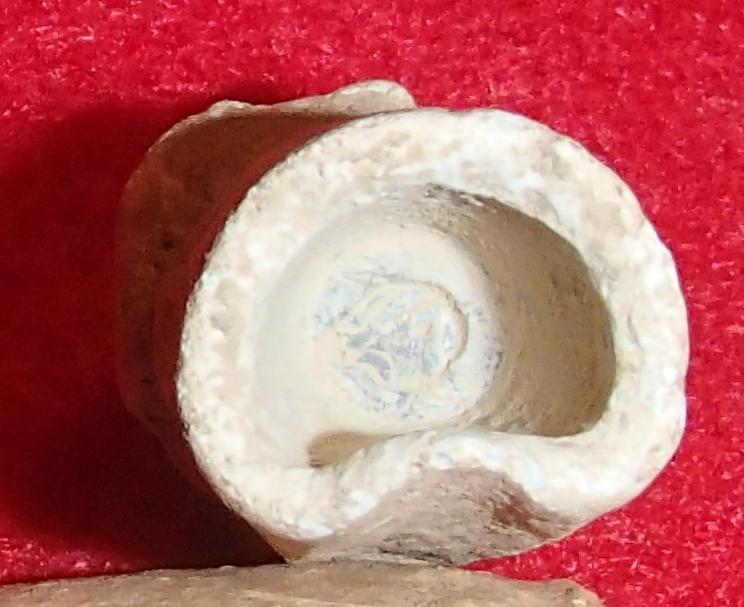
You may recall that I have previously dug Minie balls with a star in the base, showing manufacture at the Washington Arsenal.  Many Enfield bullets have base stamps as well, and this one shows a faint stamp of the number "57".  This particular bullet was produced by Eley Brothers in England, loaded onto a ship and smuggled through the Union naval blockade into the South, issued to a Confederate soldier with an Enfield rifle, and finally fired in anger at the Battle of Mine Run.  Here it lay for nearly 150 years until I was able to recover it.  What a piece of history!  Finds like this make me love this hobby even more.


This discussion of base-stamped bullets brings me back to that token RRRHA member John gave to me at the hunt.  The club decided to plant several tokens throughout the property, each stamped with a number, which could be turned in for a corresponding prize.  To keep things fair, RRRHA members were ineligible from winning the prize, and upon digging a token, were to give it to the nearest guest of the hunt.  Well, John happened to find one of these tokens just as I was walking up the same hill.  The prize turned out to be this very rare "US" stamped three ring Minie ball.  What an awesome gift!  Thank you so much to John and to the RRRHA for donating these prizes!


This was by far one of the best times I have had detecting in a long time.  The weather could not have been better, I found some things I never have before, and I even won a door prize.  But the best part was getting to spend time with great friends and making new ones.  Thanks again to everyone at the RRRHA for putting together a fantastic hunt.  Until next time, thanks for reading, and God Bless!

Thursday, April 4, 2013

DIV Recoveries Part 3: Oh, the Iron-y.

I'm back for the third and final post of my DIV finds series - the iron!  Most detectorists do their best to avoid digging iron at all costs.  We spend hundreds or thousands of dollars on machines to help us discriminate out the countless nails, farm tools, nails, fence wire, and nails that are omnipresent over just about every home site, field, and woods.  Did I mention we dig a lot of nails?

But there is a time and place for digging iron, and there are a lot of great iron relics out there waiting to be found.  One of my favorites finds from this trip is this iron heel plate from a soldiers boot, complete with the original nails to secure it to the heel.  The iron heel plate resembles a small horseshoe, and served the same purpose - to help keep the shoe from wearing out as quickly as the soldiers marched, often twenty or more miles per day.  While I was able to find quite a few images of original Civil War soldier's shoes online, few showed the bottom of the shoe.  However, I did find this virtual-museum image of a British military shoe from the 1850's, with the heel plate clearly visible.


The rest of my iron finds are fragments of exploded artillery shells.  I was really hoping to find a complete shell this time around, and while several were found in the area I was searching, I wasn't one of the lucky ones to get my coil over it.  I am still very happy with the fragments I recovered though.  They include two large sections of a 12lb round shell and several smaller pieces from unidentified shells.  Failing to find a full shell, the most sought after fragments are the tail section and the artillery fuze, and I was fortunate enough to recover one of each.


The base is from a Union Hotchkiss shell.  The shell was comprised of three parts, as shown in the cross section from the Ridgeway Reference Archive.  The top section contained the explosive charge to detonate the shell.  Around the middle section is a lead band, or sabot, used to grip the rifling in the cannon barrel.  This imparts a spin on the shell allowing for greater range and accuracy compared to a smooth bore cannon.  The bottom piece is an iron base cup, the section which I found.


The fuze I recovered is from a Federal 10lb Parrott shell.  The iron ring is the nose section of the shell itself, sheared off by the shell's internal explosion.  Within the iron ring is a white metal (zinc and lead) time fuze.  The hole in the center of the fuze would accommodate a paper fuze with slow-burning gunpowder lit by the flame of the propulsion charge as the shell left the cannon barrel.  The length of the paper fuze determined how much time passed before reaching the detonating charge inside the shell, causing it to explode.  I have also included a picture of a complete Parrott shell with the time fuze from the Ridgeway Reference Archive.

  
As always, thanks so much for reading Detecting Saxapahaw!  I love going out and saving tangible pieces of history, and I love being able to share it with all of you!  As always, if you have comments or questions, feel free to leave them in the comments section below or to email me at DetSax@gmail.com

Tuesday, April 2, 2013

DIV Recoveries Part 2: Brass and Pewter

Welcome back for the second installment showing my finds from the Diggin’ in Virginia XXIII Civil War relic hunt in Culpeper, VA.  In this post I’ll be talking about the brass and pewter finds from the hunt.  I didn’t find as much brass as I would like, but I’m still very happy with what I did find.


The first piece is this round brass ring, a rein guide (or terret) from a pulling horse harness.  This piece isn’t strictly a Civil War relic, as it may have been used on civilian or military cart horse harnesses, and could predate or postdate the war.  It is certainly possible, however, that it may have been used on any of the thousands of wagon-loads of ammunition, food, and supplies bound for the soldier’s camps we were detecting.  The reins used to control the horses pulling the wagon would have passed through the rein guide to keep them from becoming tangled.  I have also included a picture (thanks to CBG at Treasurenet for finding this one) of a modern horse harness showing the rein guides in use.


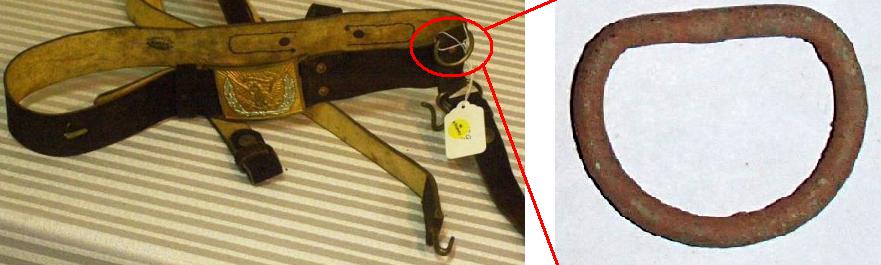
The second brass piece is a D ring from a sword belt rig.  It was found in the same Union cavalry camp where my sword belt plate was recovered last year, along with several others.  I have also included a picture of an original sword belt with D rings attached (near the price tag).

My final brass item is this great “Eagle I” infantry coat button.  The letter I in the shield denotes the branch of service – I for infantry, A for artillery, C for cavalry (or a few other less common letters like R, D, and V).  The letters were replaced with a lined shield design prior to the war for enlisted men, but the lettered buttons were still used by Union officers as well as Confederate soldiers using old button stocks during the war.


I also dug an interesting piece of pewter, which was a first for me and one of my favorite finds of the entire hunt.  It doesn’t look like much, and the condition leaves a lot to be desired, but this is a pewter spout from a canteen.  Soldiers would sometimes carve their name or initials into the spout, but deterioration from being buried for so long has eroded any letter that may have once been there.  Dug pewter can be very fragile, so this piece will be preserved to prevent further flaking.  I have also included a picture of an original M1858 canteen from the Ridgeway Reference Archive including the pewter spout.

Thanks again for reading!  Stay tuned for the next installment, the dug iron.  Trust me, it’s more exciting than it sounds.

Sunday, March 31, 2013

DIV Recoveries Part 1: Getting the lead out

Hey everyone!  I’m back from Diggin’ in Virginia XXIII, a bi-annual Civil War relic hunt.  As always, it was a blast!  I really enjoy connecting with detectorists from all over the country, seeing old friends, and making new ones.  I’d like to take a moment to give thanks to John and Rose along with the DIV committee for putting on a very professional event, John from American Digger Magazine for rooming with me, and Jeff, Dana, and Joey for the carpool and excellent company in the field.  We were blessed with great weather (excepting a few snow flurries at the end) for three full days of digging.  I saw some amazing recoveries during that time, including both Union and Confederate buckles, bullets, uniform buttons, complete artillery shells, and much more.


I’m quite pleased with my own recoveries over the course of the weekend.  I will begin with this blog post discussing my lead finds, and move on to brass, pewter, and iron in a follow-up post.  Detecting near the road I found a nice variety of different bullet types.  The most iconic and widespread bullet of the war is the three-ring minie ball.  Despite their prevalence, I only found one of these the entire weekend! I didn't photograph it for this post, but you can see numerous examples previously on the blog.


I dug two kinds of cavalry bullet, Sharps carbine and Spencer carbine.  The Sharps carbine breech-loader rifle would have originally used a paper or linen gunpowder cartridge attached to the bullet, but this has long ago deteriorated.  The Spencer repeating rifle loaded seven cartridges at a time through the buttstock of the weapon.  These cartridges were composed of a lead bullet and brass casing, although it is uncommon to recover them intact.  Shown here is a Spencer bullet with a small part of the brass casing remaining, fresh from the dirt.  I liked the look of it so much that I intent to preserve it in the original dirt as shown for future display.


Round lead bullets were in use long before the Civil War in smooth bore muskets and pistols.  Although they were eclipsed in accuracy and range by the conical Minie-ball style bullet, roundballs still saw extensive use during the war.  I found quite a few roundballs on this particular trip, from 44 to 69 caliber.


I recovered four gardner bullets which I’m particularly happy with, as I don’t tend to find many of them here in North Carolina.  These Confederate made bullets held the paper cartridge in a groove in the base of the bullet, which can be seen here.


Most of the bullets I found at DIV would be called "drops" or "dropped bullets", meaning that they have never been fired.  But I also dug these two fired bullets.  The bullet on the left obviously hit something quite hard, and is mushroomed out beyond recognition.  The bullet on the right is an Enfield bullet.  Note the ramrod mark on the nose of the bullet from where it was pushed hard into the barrel of the gun, along with the lines along the length of the bullet from where the bullet caught the rifling grooves inside the barrel as it was fired.

My favorite lead find was this highly carved Bartholow pattern pistol bullet.  The bullet was originally meant to be fired by a Colt Army revolver or similar 44 caliber pistol.  In addition to the obvious alteration around the nose of the bullet, there is also carving on the lower ring including a series of vertical lines shown here.  We may never know why a soldier took the time to create this intricately carved bullet, but many were carved as chess pieces, works of art, or simply to relieve the boredom of camp life.

That’s it for now.  Stay tuned for the next installment – my brass and pewter finds from DIV XXIII.  Thanks for reading!