Hey everyone! I got off for not one - but TWO days in a row, so naturally I grabbed the detector and was out the door as quickly as possible!!
Saturday I went back to the little camp I've been searching, but instead of returning to the same field, I decided to branch out to neighboring fields to see if the camp area extended out any further. Unfortunately I was detecting in a veritable sea of shredded aluminum cans, the bane of most every detectorist. I was only able to detect for a few hours, and the aluminum was driving me crazy, but I did manage one solitary keeper. This three ring Minie ball bullet has a star inside the base cavity, identifying it as a product of the Washington DC arsenal (now Fort McNair).
Today I met up with my friend Dustin to look for a new camp. As we pulled into the drive to ask permission to detect, a bearded gentleman emerged from the workshop behind the house. Explaining that we were looking to search the nearby field for a Civil War camp he told us that we had missed the mark. The camp wasn't in the field we suspected, but in the woods behind it, which he also owned and was happy to let us search. He also cautioned that we might not find much, explaining that it had been heavily hunted in the past and the grown up vegetation might scare us off.
Like two dauntless warriors, Dustin and I geared up and headed back into the woods. Sure enough, the area was quite overgrown, and completely undetectable in many places. So we did the best we could, hoping to eek out some finds in the "hunted out" camp. Overall we did quite well in the several hours we were there, and I look forward to returning in the winter once the undergrowth has frozen and died back.
I found a total of eight bullets, including four broken Spencer cartridges, three 44 caliber pistol bullets, and my very first Smith carbine. Unfortunately the gunpowder filled cartridges and lead bullets tend to corrode one another, and they are quite rare to find intact after 150 years underground. I only found one other piece of brass, a slightly mangled turnkey from a shoulder scale. I have previously found another turnkey right here in Saxapahaw, and more information about it can be found in that post. Dustin got the only button for the day, a beat up general service eagle, as well as a saddle fitting from a McClellan saddle.
We will certainly make a return trip, as I know there is at least one more relic to be found. I was digging up a good sounding target (I KNOW it had to be a bullet, at the very least) when the ground opened up with a deluge of bees! I had dug right into their nest, and luckily high-tailed it out of there with only one sting. MAN did that hurt! Between that, the multitude of ticks I found upon returning home, the briars, and the sunburn, it's a wonder I still want to go out at all...
But I can't wait to go back! Until next time, be safe out there everyone!
Hey everyone! Well, my schedule's been pretty tight this year, and I've been working like a dog. No
offense to dogs. BUT I did finally managed to get away last weekend and do some real
digging for the first time since DIV. Even better still, I managed to find a few Civil War relics to show for it. The artifacts were all quite shallow in a gently sloping pasture, but EMI from nearby electrical lines still made it a bit of a challenge.
The bullets are all standard three ring Minie balls. The lead glob shows just enough of the rings to know it had been a bullet as well, before it melted. The large brass object is a bayonet scabbard tip. I have found both the tube and finial portions of a scabbard tip in the past, but this was my first time finding them both still attached.
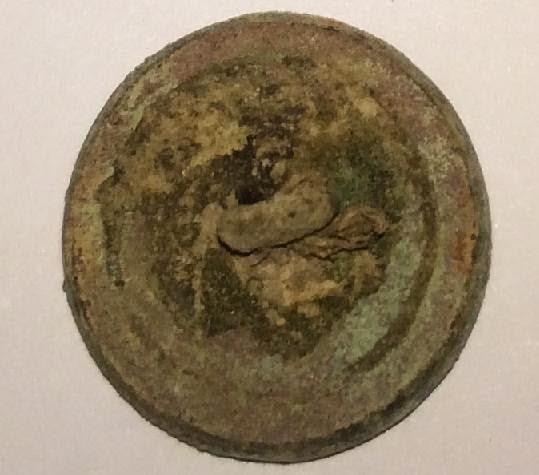
The smaller button is just a back, the front having been previously
destroyed. Miraculously though, it still has some thread on the
shank. this is only the second period button I have found with thread
intact, the first being a Virginia coat button found right here in Saxapahaw.
The large, highly gilded button is a civilian "flower button" featuring a grape and leaves motif. The button backmark is
"Benedict and Burnham Extra." Aaron Benedict and Gordon Burnham manufactured buttons with this mark from 1834 to 1849, before the company was reorganized as the Waterbury Button Company, which still exists to the present day. Benedict and Burnham buttons are well known to collectors as having excellent gold gilding, and many dug examples retain a significant amount of gold. Although not a military button and designed exclusively for civilian clothing, similar buttons (and even this exact style) are often found in and around Civil War campsites. It is very likely, given the lack of other period household items, that this button was soldier-worn. Of course, we will never know for certain, as the nearby road predates the War by many decades.
The signal that got me down into the ash layer of the fire
pit on the first day at Brandy Rock Farm is still a mystery object.It’s a large, flat, and iron, but beyond that
I have no idea what it is!Any help
would be greatly appreciated!What I do
know is that it gave a good signal, and upon digging it out the black charcoal
of a Civil War soldier’s fire could be clearly seen.
I found the charcoal layer by detecting this iron...... thing?
I continued to expand the fire pit, following the ash layer and checking the
side walls with my pinpointer as I went along for metal targets.The dark charcoal layer was easy to follow,
and the brown disturbed earth showed an excellent contrast to the hard clay
walls surrounding the pit.In addition
to the mystery iron object, I recovered an iron knife, parts of a horse shoe,
and three iron four-hole buttons.The
brass finds from the pit included a J hook, a knapsack triangle hook, two large
belt studs, a poncho or tent grommet, and a coat size button back.The pit also contained a large number of
broken glass shards, and I was able to reconstruct most of a bottle of John
Gibson Sons Co’S / Choice Old / Bourbon Whiskey.What I particularly love about this bottle is
how it is twisted and contorted by the heat of the soldier’s fire!
Reconstructed bourbon whiskey bottle melted from the fire.
The real find of the hut, though, is what detectorists refer to as a “pocket
spill”.It’s a term usually used by
coin-shooter looking for fairly modern coins, and refers to a small collection
of coins found together.It’s not every
day you run across a pocket spill from a Civil War soldier, though!This one consisted of three coins.The first is an Indian Head penny.The date is unreadable, but it certainly
predates 1864 when the thickness of the penny was reduced to what we see today.The other two coins are a bit different, and
certainly rank among my favorite finds of my detecting career.
Brass and copper finds from the hut.
At the onset of the war, private citizens began hoarding money for fear of
economic turmoil.This began with gold
and silver coins, and moved on to the hoarding of copper coins as well.This led to a shortage of coins in
circulation, which was clearly a problem for businesses.As a result, some businesses took to minting
their own coins, getting around counterfeiting laws by omitting any
denomination and minting them as “patriotic tokens”, typically with pro-Union
slogans or images.These non-currency
coins ran afoul of the United
States government who outlawed the practice
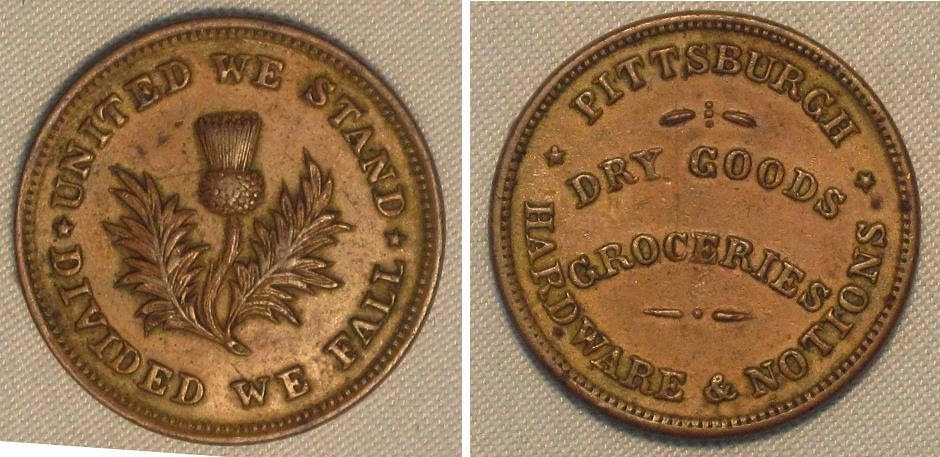
in 1864.The two coins I found in my pit
are patriotic Civil War tokens, minted with the same dimensions as a
penny.One side of the coin reads
“Pittsburgh Dry Goods Groceries Hardware & Notions”.The other side shows the image of a thistle plant with the slogan
“United We Stand, Divided We Fall”.There are few detecting finds which embody the American Civil War to
such an extent, and I fell blessed to have recovered them.
Thank you so much to John and Rose and the entire DIV committee for the
invitation and for putting on such a well run event.And thanks to you, my readers, for making it
all the way through my long-winded posts!Hopefully I will have an opportunity to do some more digging soon, but
with Spring ramping up work around the farm, well… I’ll see what I can do!
I really can’t say enough what a special place
Brandy Rock Farm is, and how privileged I feel to have been able to attend two
DIV events on this historic property.Brandy Rock was the home of the Union 6th Corps during the winter of
1863 to 1864.The hunt started with a
heavy blanket of snow over the fields, left over from the snow during the
Spillman Farm hunt two days prior.Warmer
temperatures came in and melted the snow quickly, leaving everything coated in
a sticky reddish-brown mud on day one.Yuck!
Brandy Rock in the mud!
My finds were less numerous than they have been in the past, but DIV XXVII was
one of the most fun times I’ve had in this hobby.I tried to start in a known Confederate area
with my friend Keith, but quickly abandoned that tactic, as the targets were
simply too deep under the snow and grass for my VLF machine to hear.Instead I went back where I left off at the
end of the last Brandy Rock hunt – the field by the headquarters tent.It didn’t take long before I found myself in
a shallow fire pit with a very strong ash line.I spent much of the day
exploring the fire pit, following the charcoal line and checking for signals.I’ll tell you more about those finds further
along, but I recovered some of my favorite relics of my detecting career in
that soldier’s fire.
Phil on "Wisconsin Hill"
My good friend Phil got into several pits in the area near headquarters.One of the highlights of my hunt was watching
him pull bullet after bullet from the bottom of a two foot hole.The total was 20 three ring bullets exactly,
along with neatly stacked percussion caps.Congrats again, that was a great find!Later, Phil also pulled an iron tube-like object out of another deep
hole on the same hill.He showed it to
me, commenting that it looked like a scabbard of some kind, and wanted to know
if I had the desire to dig up the bottom piece several feet in the ground.Now that was a deep hole!Of course I jumped on the chance, and sure
enough I recovered the iron scabbard drag at the bottom.I expanded the hole outward, and recovered
several iron buckles and a knapsack hook, but not much else before reaching
hard packed clay on all sides.I was
also gifted a pile of broken glass from another one of Phil’s huts, which I was
able to reassemble into a mostly complete Dyottville Glassworks Co. Phil.
Patent whiskey bottle.Thanks again,
Phil!
Sword scabbard and reconstructed whiskey bottle
Surface hunting in that same area yielded several more bullets, knapsack parts,
and three coat buttons – two eagle I infantry coat buttons and one New York coat
button.On day two, I went with my
friends Phil, Todd, and Brian to detect near Farley House.Built in 1790, Farley was occupied by both
armies and used as the headquarters for the Union
6th Corps winter encampment.Phil found quite a few bullets in this field, but my finds were less
plentiful – one small pistol bullet and a large grapeshot or canister shot for
a cannon.Brian and Todd both found
canister shot balls of the same caliber, so there clearly must have been artillery
near by.Todd had the best find in the
field near Farley, a Richmond
cavalry spur.It really gave me chills
to be searching for artifacts so close to such a historic piece of
architecture, walking around close to where the famous picture of General
Sedgwick on the Farley house steps was taken.Even without a lot of finds, taking the time to appreciate that location
was definitely worth it.On the third
day I went up to “Wisconsin Hill” with this same group of friends, and here I
recovered one bullet and an iron sling attachment for a rifle.I also got into a pit loaded with some of the
darkest charcoal I’ve run across, and iron signals galore, but after much
effort (and moving many HUGE stones to get to the ash layer underneath), the
only thing I got for my trouble was square nails and mud!You can’t win em all!
Todd detecting in front of Farley House
Oh right, the pit on day one!This post
has gotten long enough, so I’ll just have to leave you in suspense!
My finds from Brandy Rock Farm, not including the fire pit.
The Spring 2014 Diggin in Virginia
invitational hunts kicked off with three days at the Spillman Farm in Brandy
Station, Virginia.The Battle of Brandy Station comprised the
largest cavalry engagement of the war, and the rolling hills surrounding the
town served as home to the Union army during the winter of 1863 to 1864. To say that March weather in Virginia
is unpredictable would be an understatement of the highest order.Despite being held in the last week of the
month, DIV XXVI was greeted with a snowstorm on the second day that made
detecting more than a little difficult.Cold winds continued on the third day, and the melting snow turned
everything into a muddy, soupy mess.Still, we diggers persevered, and I saw some incredible recoveries made
despite the inclement weather.
Snow at Spillman Farm
My finds for the hunt were modest compared to some of my previous DIV
hunts.This was partly due to the
weather, but I also devoted quite a bit of my detecting time to hunting for
shells.I removed a lot of big farm iron
from the heavily shelled field on “Site 2”, and while I did find quite a few
shell fragments, the unexploded ordinance eluded me.My good friend Todd, on the other hand, was
more successful, recovering a 12 pounder spherical shell in the big field on
“Site 1”.Congratulations, Todd!
Todd and his cannonball
I did find several bullets, including three ring Minie balls, Sharps carbine,
and a round ball which was probably shrapnel from inside
an exploding shell.My best bullet is a fairly rare CS Richmond Merrill bullet. My button
recoveries included a very nice condition general service eagle coat button, as
well as a civilian flat button and cufflink or period or pre-war design.My heart-breaker for the hunt was the back of
a two piece button, which doesn’t appear to be a standard Union back, recovered
in the front field where many Confederate buttons have been found in the
past.Unfortunately the front of the
button was lost or destroyed before I got to it, so we’ll never know what it
might have been!
CS Richmond Merrill Carbine bullet on the left.
Most of my iron finds were shell fragments from Parrott and 12 pound spherical
shells, but I did find a few other interesting iron relics.These include half of a soldier’s heel plate,
an iron barrel band from a rifle, and the pull chain from a soldier’s canteen
stopper. The large medallion in the center of my finds picture was by far the best
sounding signal of the entire hunt on my VLF machine.I knew it was shallow, but I was really
hoping for a big brass relic.Unfortunately
it turned out to be a medal commemorating the 1999 reenactment of the Battle of
Brandy Station!Oh well, better luck
next time!!
My Spillman Farm recoveries.
Despite the snow and wind, despite the cold and the wet, DIV XXVI was a
blast!I had a great time seeing many of
my digging friends, and finding some relics together.The harsh weather conditions for the end of March did serve to make us
all think about the living conditions of the men who left those artifacts
behind.Those brave soldiers lived,
worked, and trained during the cold winter months in those same snow-covered
fields.They endured the wind, rain,
snow, and mud day in and day out, many without adequate clothing or even
shoes.Inadequate sanitation and close
quarters led to widespread disease.Mud-soaked roads made transportation of supplies challenging.Those men endured all of these conditions to
fight for what they believed in.Although
it made metal detecting a challenge, I think all the participants of DIV XXVI
found a dose of perspective at this year’s event.
Original sketch of a Union winter camp in the snow by Edwin Forbes
I can't believe it's been so long since my last update! Trust me, it's not because I haven't wanted to. For those curious, I took on a second job to help pay off my student loans, and the schedule has been a bit intense. Between all the work and the crazy weather we've had this winter, I've barely had time to stop and take a breath, let alone a day of detecting.
I did get out last month, though - first for a day of detecting in Fredericksburg, VA followed by the "Diggin' in Virginia" Spring 2014 invitational hunts. Fredericksburg is the home of Mary Washington College, my alma mater, so detecting nearby was something of a homecoming. I had the pleasure of meeting two new friends, Dustin and Rod, in the search for relics. Dustin is not new to detecting, but recently returned to the hobby after a hiatus. Rod graciously allowed us to detect his historic property, and came along for his first time using a detector.
General William Averell
The property was associated with the camps of General Averell's Federal Cavalry in the winter of 1862 - 1863. The Army of the Potomac was still reeling from a crushing defeat at the Battle of Fredericksburg, and harsh weather made campaigning impossible. Captain William Hyndman of the 4th PA Cavalry described the winter in haunting fashion. He writes:
All the long, cold winter of 1862 and '63, we did picket duty, almost continually, in the vicinity of Hartwood Church, a distance of eight miles from camp. We were generally three days out and three in, in the meantime making scouts and reconnaissances. Each was seldom in camp more than a day at a time. We had a long and exposed line to guard, and had to scout the country in the vicinity of our forces, in order to guard against raids and surprises by any large body of the enemy.
While performing this duty on the picket line, which was in many respects a perilous one, we were exposed to the inclemencies of a long, dreary, and bitterly cold winter, in a country which displayed only far stretches of dense pine forests, and bleak, open glades and fields, almost uninhabited and unclaimed. Here lonely and alone, we paced the frozen ground with no companionship but that of our carbine, sabre, and pipe - the latter being require to yield its utmost of comfort and delight. How often then, as the sombre, leaden pall of clouds would move up the skies, darkening the chill though pleasant sunlight from the scene, and letting fall the first light sprinkles of the snow, to be thickened and whirled in icy mists about the face and over the whitening woods and meadows, have our thoughts reverted to the happy hearth at home, at which the loved ones were gathered and, perhaps, reflecting in turn upon our own trials and perils on the field of battle.
Fortunately the weather for our hunt was not nearly so unpleasant. The rain showers held off, and we were able to recover a few cavalry relics along the bank of a shallow creek. Dustin recovered a coat button back, several pack grommets, and a massive piece of melted "camp lead". Rod recovered a dropped Sharps carbine bullet, his first CW relic with a detector. Congrats, Rod - once you've found that first bullet, you're hooked!
Dustin examines his button back fresh from the ground.
My finds included two cavalry bullets, a Sharps carbine and a Barthalow pattern pistol bullet. I found part of a third bullet as well - a small carved sliver of a three ring Minie ball. For brass, I recovered a knapsack J hook and a coat button, and large brass ring (not pictured) which was probably horse tack related. The J hook has a longer, thinner, and more pointed wire than I am used to seeing on most typical J hooks. Any thoughts or opinions on that piece are welcomed.
My finds for the day.
The button is my favorite find of the day, even though it's in quite rough shape. I incorrectly identified it in the field as a General Service eagle coat button. I got a surprise when I was cleaning it up at home, though - inside the shield on the eagle's chest is a letter "C", denoting it as a cavalry button. It's my first "eagle-C", and I'm thrilled to have found it at a site so conclusively tied to Averell's cavalry in the winter of 1862-63.
This is part two of the recap of my 8 day detecting trip to Culpeper, VA. Part one talked about our pre-hunt and Diggin' in Virginia XXIV at the Excelsior Brigade camps. We had a one day break between DIV XXIV and XXV, so how else could we spend it? We went metal detecting of course! I went out to a site with some of my good friends, and while I ended up getting skunked on finds, I still had a lot of fun looking. Almost everyone in our group found some Civil War relic, so I got to enjoy their finds as well as excellent company.
Then it was off to DIV XXV at Brandy Rock Farm. The farm included part of the Battle of Brandy Station, as well as winter quarters from the Union 6th Corps during the winter of 1863 - 1864. The property we detected didn't include the historic Farley House (also known as Welford House), but we were able to search many of the nearby fields and woods. Farley was the headquarters for Union General John Sedgwick and Confederate General JEB Stewart, though obviously not at the same time!
Union General John Sedgwick and officers of the 6th Corps at Farley House, winter 1863 - 1864.
Day 1
The start of DIV XXV was a cold one! With frost covering the frozen ground, we made our way out onto the farm. I tried to start in a small patch of woods, but I wasn't the only one with that idea. Between other detectorists and the briars, I didn't have much luck and didn't stay long. Instead, I joined my friends Phil and Todd in a nearby field. Todd was having some luck with a rare Confederate New Austrian bullet, and we all pulled out a few deep targets. Unfortunately, given the depth of the relics in that field, the mineralization of the ground, and the taller grass I was struggling to hear the good targets. While I did find a pair of three ring bullets in that area, I felt I could do better elsewhere and joined my friends Lanny and Lisa on a nearby hill. Not fairing much better there, I continued to look for my "spot" where I could hunker down for the hunt. I finally decided on the soybean field near the headquarters tent, home to a large Union 6th corp encampment. The shorter crop field helped get my coil closer to the ground, and I did have some better luck.
Detecting in the soybean field at Brandy Rock Farm
Several large holes from 6th corp winter huts were starting to open up in the soybean field. One of these was my friend Kieth, who got an impressive array of relics from below the plow line, including two complete bottles, bullets, buttons, clay pipes, and a canteen half. I was thrilled to be able to watch him work. I did get into one pit of my own, the signal coming from a complete barrel band. While the hole was filled with considerable ash and even some larger pieces of broken glass, I only recovered one other relic from hole. At first I thought it looked like modern plastic, but was quickly ID'ed by my friend Todd as a broken piece of a soldier's comb. Sure enough, as I rubbed the dirt from the object I could see a maker's mark from the India Rubber Comb Company, Goodyears Patent May 6 1851. The Goodyears patent refers to the rubber vulcanization process, developed by Charles Goodyear, namesake of Goodyear tires. It would have probably been used for de-lousing, as body lice were a significant problem in Civil War camps.
Broken comb recovered from a hut on day one.
Day 2
I started off day 2 by following a group of friends to a spot where Brian had done well the day before. But again the mineralized ground and taller grass had me struggling to hear the good signals. Before long I wandered back up to a hill near the headquarters tent where I had some success at the end of the day before. With my VLF detector unable to discriminate conductivity at depth in the hot soil, I instead relied on the pinpoint mode to pick out targets based on size and depth ratio. What that also means, unfortunately, is digging square nails. Lots and lots of square nails. They weren't all nails though - some of those targets turned out to be bullets or other relics from the war.
A three ring Minie ball bullet comes into view.
I was pursuing another target right in a huge patch of iron, when I saw something exciting in the bottom of the hole. A rounded edge standing straight up on end, with a green brass front and white lead back. I had my finger crossed that it would be an accoutrement plate of some kind, although I resisted using the "p" word on camera so I didn't jinx it! I was elated when I finally pulled it from the ground to reveal a US cartridge box plate! This makes my fifth Civil War plate find, three of which have come from DIV events.
The edge of the plate in the bottom of the hole.
US Cartridge Box Plate.
Soldiers during the war carried a leather pouch to hold their ammunition, known as a cartridge box. A leather flap closed the box to keep out water and dirt, and the flap was kept closed by fastening it to a brass finial on the bottom of the box. To help make sure the flap remained closed when it was unfastened, a large oval plate with a brass front and lead filled back was attached to weight it down. The design I recovered was used by the Union army bearing the large letters "US" in the same style as the US belt plate. The US box plate can be seen in use in the picture of this unidentified Union soldier below.
Unidentified Union soldier, wearing a cartridge box with a US box plate.
Day 3
Having success in the soybean field on the previous days, I decided to return for the third. Once again I dug more than my share of nails, but several excellent relics as well. I dug a thrilling "first" for me, a New York coat button. In addition to being my first NY, it is in fact my first Union state button of any sort. I also recovered an excellent carved bullet, most likely a chess piece. This carved bullet was the nicest of several carved lead piece I recovered during the hunt.
New York coat button, my first Union state, and an intricately carved bullet
Another highlight of the third day came when I stopped by a newly opening pit being dug out. I introduced myself, and learned that the detectorist, Ed, had been digging huts in the area for many years. He was kind enough to take his own precious detecting time to teach me some lessons in hut digging. When we got to the bottom, we found the signal coming from an intact ration can, with little else but charcoal and animal bone in the hole. Being an experience hut digger, Ed told me he had plenty of ration cans in his collection and offered it to me! The kindness of the folks at DIV never ceases to amaze me. There's a reason John and Rose refer to Diggin' in Virginia as a "family"! The barbeque on day three was quite fun as always. I love getting the
chance to eat with my friends and see an impressive museum on display,
freshly saved from beneath the earth. We kept on swinging a coil until the sun was nearly set, hoping for that one last relic to save. With darkness closing in, I climbed back into the truck to start the long journey back home to Saxapahaw.
Reflections on DIV XXV
This was my first time at Brandy Rock Farm, and it certainly did not disappoint! Although the ground was some of the hottest I've come across yet, I still managed to find some great artifacts from the American Civil War. My friends all made some great recoveries as well, especially Beau who racked up on bullets and Brian who recovered an amazing engraved corps badge. The box plate was a welcome surprise in the hole, and one I will always fondly remember. All of my finds from the three days at Brandy Rock can be seen below.
All my finds from DIV XXV
I would also like to share part two of my video footage from the week. I hope you enjoy it as we watch a few relics come to the surface for the first time since they were lost or discarded 150 years ago.
The week in Virginia seemed to go by all too quickly, and although I was stiff and sore, I was sad for it all to end. I want to take this time to thank John and Rose Kendrick and the DIV committee for giving me the opportunity to return to DIV; I am incredibly grateful. All their hard work paid off with two highly successful back-to-back events, which seemed to go off without a hitch. I would also like to thank Phil, Lanny, and Lisa for their hospitality during the week - it was a lot of fun getting to spend time with you between detecting. Thanks to Todd and Brian in the carpool and all my DIV family for an amazing week of relic hunting. Thank you to Sham and Randy for the break day hunt, even though I didn't find any relics, I found great memories! Finally, thank you to my wonderful wife Emily and the VCS volunteers who made it possible for me to attend.
I hope to have more finds to share with you all soon, but until then, thanks for reading and God Bless!