Sunday, September 7, 2014

Equipment Review: Deteknix X-Pointer

Recently I've been hearing some buzz about a new pinpointer on the market, called the X-Pointer by Deteknix.  Being curious, I send an email over to my good friend Keith at Fort Bedford Metal Detectors for some input.  As it turns out he had just gotten some in stock, and wanted to try them out as well, so he suggested we get together and see what they were all about.  Full disclosure up front - I'm not being incentivized by Fort Bedford nor Deteknix to write this review, so you'll get the honest scoop on this product.  The hype behind the X-Pointer was rather built up on the web, so it had some pretty high expectations from the start.  Spoiler alert: the X-Pointer delivered.


I'll begin with the construction.  It strongly resembles Garrett's ProPointer, the gold standard in the handheld pointer market.  The hard plastic exterior seems robust, and should hold up well.  For accessories, it comes with a fairly standard belt holster, four "tip caps" (more on these later), and a coiled lanyard.  The lanyard seems like a great idea, but I didn't use it for this review, and I'll tell you why.  Although the keychain rings on the lanyard are metal, the snap-clip is a pretty chintzy feeling plastic.  It was the only part of the packaging that I felt appeared weak, and since I was using Keith's pinpointer, I didn't want to break it and left the lanyard at the truck.  I will probably replace it with a sturdier clip at some point.
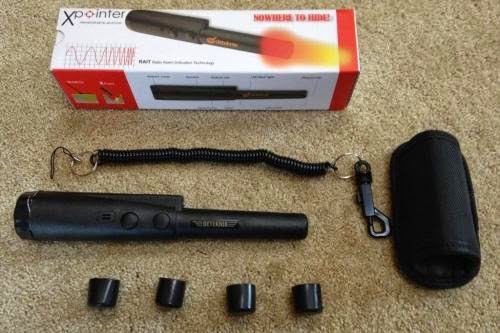

Onwards to ease of use.  Detection occurs at the tip as well as up the shaft to about the X in the word Deteknix.  I found it quite intuitive to change between audio/vibrate modes as well as the four tiered sensitivity settings.  Although there was some decrease in detecting distance with lower sensitivity, air testing didn't show a huge difference between the various settings.  It was, however, more than adequate on all settings.  But enough air testing, lets talk about real world use.

We spent a day out detecting at two different sites, one with good non-mineralized soil, and the second that I would describe as moderate to high mineralization.  The number one catch phrase that caught my attention about the X-Pointer was - "I can't get it to false!"  And I will give that statement a qualified "true."  As far as pushing, twisting, scraping the pinpointer in the hole, I absolutely could NOT get it to false.  Not a chirp.  Remember those tip caps I told you about?  At first I thought they were a neat but unnecessary add on.  After using it for a day, I can see why they were included.  Since it doesn't false from pressure, you really can use the pinpointer to scratch around in the dirt with pretty good force.  That's probably what most impressed me from the X-Pointer, and I really feel it's what makes this unit a step above the competition.


Now I did say that "I can't get it to false" was true to a certain point, and here's the limitation.  The X-Pointer is fairly unique in that it's a pulse induction pinpointer, and that would lend one to believe that it would be unaffected by ground mineralization.  I didn't find that to be the case.  While the unit worked great in the neutral field on full sensitivity, the hot-ground field would still cause some falsing on just clay.  The falsing was worst when more of the shaft was in contact with the dirt, rather than just the tip.  I tried the "ground balancing" technique that I use with my Garrett ProPointer, and the result was the same - the falsing went away, but took with it much of the depth and sensitivity.  Unlike the ProPointer, however, the X-Pointer offers another solution.  I simply turned the sensitivity level down from four (max) to two in the hot-ground field, and voila!  No more falsing.  The depth decreased a little from the maximum setting, but not nearly the same extent as when ground balanced.  So again, one more point in the X-Pointer's column.

Alright now lets get down to brass tacks.  Retail price?  $89.00.  Compare that to the $130-ish for the Garret, and even more for the Minelab.  Wow.  Enough said.


To recap - Doesn't false from pressure for extreme use.  Adjustable sensitivity for hot ground.  Easy to use.  Depth comparable to the others on the market.  And a better price.  The ONLY question mark remaining is the longevity, and that we'll have to wait to see.  So for now, I'm sold on the X-Pointer.  It would make a great addition to any detectorists arsenal, and my first recommendation for new hobbyists.  Well done, Deteknix, and thank you for a great product that I look forward to using as my primary handheld unit for years to come.  If you're so inclined, head on over to Fort Bedford and pick up one for yourself.

Published in American Digger Magazine - Hot Tips for Hot Dirt

Hey everyone!

As you may know, I have been a regular attendee at the bi-annual Diggin' in Virginia events for the past several years.  The red clay of Culpeper, Virginia is highly mineralized, and can make detecting significantly more challenging.  Pulse induction technology metal detectors have help significantly with the mineralization problem, and are the predominant machines at such hunts.  Unfortunately they also have some pretty hefty price tags compared to a traditional VLF machine like my trusty White's DFX.


While I am by no means an expert, I do feel that I have been rather successful at hot-ground relic hunting with a VLF detector, thanks in large part to a few simple tricks I picked up along the way.  I shared those techniques with American Digger Magazine, and the article was just released in the September-October issue (Volume 10, Issue 5).  If you are interested in checking it out, you can order a subscription over at http://www.americandigger.com, or download a digital copy here.


I actually haven't gotten my copy in the mail yet, but I expect to arrive any day.  If any of my readers have gotten their copy yet, drop me a line in the comments and let me know what you thought!  Oh, and speaking of Diggin in Virginia.... I got my invite, so I'll have another DIV recap coming in late October.  WOOHOO!

Tuesday, July 1, 2014

"Spencer" update - Rare Sharps and Hankins cartridges

I just stopped in to post a quick update and correction on last weekend's relic hunt post.  I posted pictures of my finds on several internet forums popular with Civil War detectorists and received some interesting feedback.  While I did notice something seemed a bit differs about the Spencer bullets and casings I found than what I have recovered in the past, I assumed they were simply a Spencer variant.  The oxidation of the bullet from close proximity to the casing and gunpowder confused the ID as well.


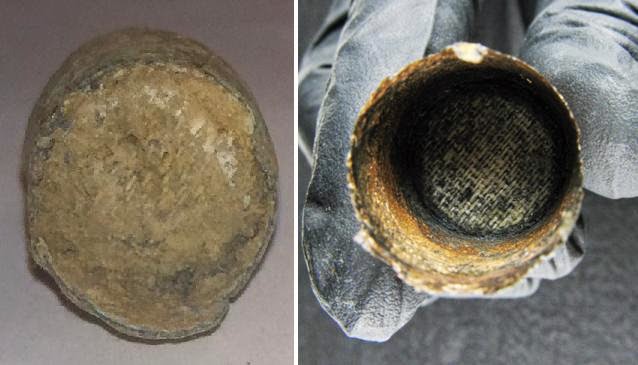
It turns out that what I thought were relatively common Spencer carbine bullets are actually much more rare Sharps and Hankins cartridges.  This can be seen most clearly on the second bullet from the left in the previous post, and a larger picture of that bullet is shown here.  These bullets were designed for the Sharps and Hankins carbine, a product of a short wartime partnership between the two weapons manufacturers..  About 8,000 S&H rifles were made, with more than 6,600 of these produced for the Navy and the remainder (about 1500 units) for the Army and Cavalry.  This may seem like a large number, but for comparison, there were more than 100,000 Spencer carbines and rifles produced for the war, and 700,000 Springfield rifles.

Rim-fire cartridges recovered from the wreckage of the USS Monitor. 
USS Monitor Center Blog

Interestingly, several parts of a Sharps and Hankins rifle and four S&H type rim-fire cartridges were recovered from the wreckage of the famous USS Monitor.  These cartridges are shown above, and more details can be found at the USS Monitor Center's blog here and here.  The Monitor Center's blog also shows a cloth patch on the inside of the cartridge, between the bullet and the powder charge.  It is speculated that the fabric was intended to help keep the powder dry in case the cartridge was subjected to wet conditions.  Further cleaning of my recently dug S&H cartridges does show remains of similar cloth fragments inside the cartridge!

The preserved fabric barrier between the bullet and powder chamber in one of my
S&H cartridges (L) and a cartridge recovered from the USS Monitor (R).

Sunday, June 29, 2014

Bullets, Brass, and BEES

Hey everyone!  I got off for not one - but TWO days in a row, so naturally I grabbed the detector and was out the door as quickly as possible!!

Saturday I went back to the little camp I've been searching, but instead of returning to the same field, I decided to branch out to neighboring fields to see if the camp area extended out any further.  Unfortunately I was detecting in a veritable sea of shredded aluminum cans, the bane of most every detectorist.  I was only able to detect for a few hours, and the aluminum was driving me crazy, but I did manage one solitary keeper.  This three ring Minie ball bullet has a star inside the base cavity, identifying it as a product of the Washington DC arsenal (now Fort McNair).


Today I met up with my friend Dustin to look for a new camp.  As we pulled into the drive to ask permission to detect, a bearded gentleman emerged from the workshop behind the house.  Explaining that we were looking to search the nearby field for a Civil War camp he told us that we had missed the mark.  The camp wasn't in the field we suspected, but in the woods behind it, which he also owned and was happy to let us search.  He also cautioned that we might not find much, explaining that it had been heavily hunted in the past and the grown up vegetation might scare us off.

Like two dauntless warriors, Dustin and I geared up and headed back into the woods.  Sure enough, the area was quite overgrown, and completely undetectable in many places.  So we did the best we could, hoping to eek out some finds in the "hunted out" camp.  Overall we did quite well in the several hours we were there, and I look forward to returning in the winter once the undergrowth has frozen and died back.


I found a total of eight bullets, including four broken Spencer cartridges, three 44 caliber pistol bullets, and my very first Smith carbine.  Unfortunately the gunpowder filled cartridges and lead bullets tend to corrode one another, and they are quite rare to find intact after 150 years underground.  I only found one other piece of brass, a slightly mangled turnkey from a shoulder scale.  I have previously found another turnkey right here in Saxapahaw, and more information about it can be found in that post.  Dustin got the only button for the day, a beat up general service eagle, as well as a saddle fitting from a McClellan saddle.


We will certainly make a return trip, as I know there is at least one more relic to be found.  I was digging up a good sounding target (I KNOW it had to be a bullet, at the very least) when the ground opened up with a deluge of bees!  I had dug right into their nest, and luckily high-tailed it out of there with only one sting.  MAN did that hurt!  Between that, the multitude of ticks I found upon returning home, the briars, and the sunburn, it's a wonder I still want to go out at all...

But I can't wait to go back!  Until next time, be safe out there everyone!

Sunday, June 15, 2014

Finally got my coil to the soil again!

Hey everyone!  Well, my schedule's been pretty tight this year, and I've been working like a dog. No offense to dogs. BUT I did finally managed to get away last weekend and do some real digging for the first time since DIV.  Even better still, I managed to find a few Civil War relics to show for it.  The artifacts were all quite shallow in a gently sloping pasture, but EMI from nearby electrical lines still made it a bit of a challenge.


The bullets are all standard three ring Minie balls.  The lead glob shows just enough of the rings to know it had been a bullet as well, before it melted.  The large brass object is a bayonet scabbard tip.  I have found both the tube and finial portions of a scabbard tip in the past, but this was my first time finding them both still attached. 


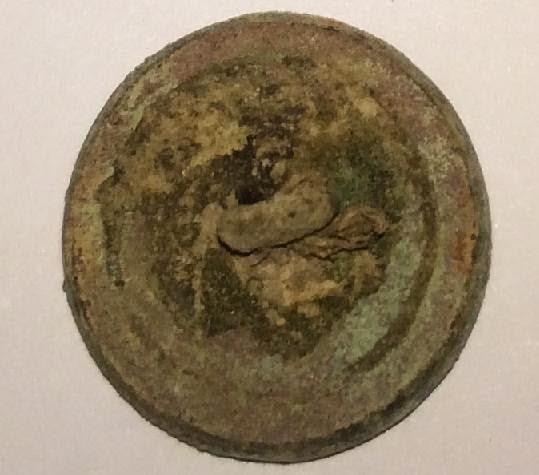
The smaller button is just a back, the front having been previously destroyed.  Miraculously though, it still has some thread on the shank.  this is only the second period button I have found with thread intact, the first being a Virginia coat button found right here in Saxapahaw.


The large, highly gilded button is a civilian "flower button" featuring a grape and leaves motif.  The button backmark is "Benedict and Burnham Extra."  Aaron Benedict and Gordon Burnham manufactured buttons with this mark from 1834 to 1849, before the company was reorganized as the Waterbury Button Company, which still exists to the present day.  Benedict and Burnham buttons are well known to collectors as having excellent gold gilding, and many dug examples retain a significant amount of gold.  Although not a military button and designed exclusively for civilian clothing, similar buttons (and even this exact style) are often found in and around Civil War campsites.  It is very likely, given the lack of other period household items, that this button was soldier-worn.  Of course, we will never know for certain, as the nearby road predates the War by many decades.

Wednesday, April 2, 2014

DIV XXVII: Brandy Rock Farm Part 2

The signal that got me down into the ash layer of the fire pit on the first day at Brandy Rock Farm is still a mystery object.  It’s a large, flat, and iron, but beyond that I have no idea what it is!  Any help would be greatly appreciated!  What I do know is that it gave a good signal, and upon digging it out the black charcoal of a Civil War soldier’s fire could be clearly seen.

I found the charcoal layer by detecting this iron...... thing?

I continued to expand the fire pit, following the ash layer and checking the side walls with my pinpointer as I went along for metal targets.  The dark charcoal layer was easy to follow, and the brown disturbed earth showed an excellent contrast to the hard clay walls surrounding the pit.  In addition to the mystery iron object, I recovered an iron knife, parts of a horse shoe, and three iron four-hole buttons.  The brass finds from the pit included a J hook, a knapsack triangle hook, two large belt studs, a poncho or tent grommet, and a coat size button back.  The pit also contained a large number of broken glass shards, and I was able to reconstruct most of a bottle of John Gibson Sons Co’S / Choice Old / Bourbon Whiskey.  What I particularly love about this bottle is how it is twisted and contorted by the heat of the soldier’s fire!

Reconstructed bourbon whiskey bottle melted from the fire.

The real find of the hut, though, is what detectorists refer to as a “pocket spill”.  It’s a term usually used by coin-shooter looking for fairly modern coins, and refers to a small collection of coins found together.  It’s not every day you run across a pocket spill from a Civil War soldier, though!  This one consisted of three coins.  The first is an Indian Head penny.  The date is unreadable, but it certainly predates 1864 when the thickness of the penny was reduced to what we see today.  The other two coins are a bit different, and certainly rank among my favorite finds of my detecting career.

Brass and copper finds from the hut.

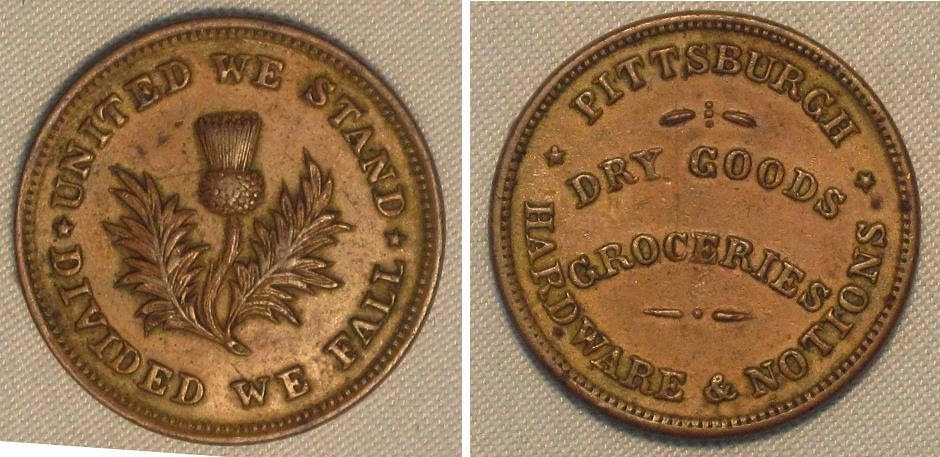
At the onset of the war, private citizens began hoarding money for fear of economic turmoil.  This began with gold and silver coins, and moved on to the hoarding of copper coins as well.  This led to a shortage of coins in circulation, which was clearly a problem for businesses.  As a result, some businesses took to minting their own coins, getting around counterfeiting laws by omitting any denomination and minting them as “patriotic tokens”, typically with pro-Union slogans or images.  These non-currency coins ran afoul of the United States government who outlawed the practice in 1864.  The two coins I found in my pit are patriotic Civil War tokens, minted with the same dimensions as a penny.  One side of the coin reads “Pittsburgh Dry Goods Groceries Hardware & Notions”.  The other side shows the image of a thistle plant with the slogan “United We Stand, Divided We Fall”.  There are few detecting finds which embody the American Civil War to such an extent, and I fell blessed to have recovered them.

The hut coin spill.
The same token in non-dug conditions seen here.

Thank you so much to John and Rose and the entire DIV committee for the invitation and for putting on such a well run event.  And thanks to you, my readers, for making it all the way through my long-winded posts!  Hopefully I will have an opportunity to do some more digging soon, but with Spring ramping up work around the farm, well… I’ll see what I can do!

All my finds from the Brandy Rock fire pit!

DIV XXVII: Brandy Rock Farm Part 1

I really can’t say enough what a special place Brandy Rock Farm is, and how privileged I feel to have been able to attend two DIV events on this historic property.  Brandy Rock was the home of the Union 6th Corps during the winter of 1863 to 1864.  The hunt started with a heavy blanket of snow over the fields, left over from the snow during the Spillman Farm hunt two days prior.  Warmer temperatures came in and melted the snow quickly, leaving everything coated in a sticky reddish-brown mud on day one.  Yuck!
Brandy Rock in the mud!

My finds were less numerous than they have been in the past, but DIV XXVII was one of the most fun times I’ve had in this hobby.  I tried to start in a known Confederate area with my friend Keith, but quickly abandoned that tactic, as the targets were simply too deep under the snow and grass for my VLF machine to hear.  Instead I went back where I left off at the end of the last Brandy Rock hunt – the field by the headquarters tent.  It didn’t take long before I found myself in a shallow fire pit with a very strong ash line.  I spent much of the day exploring the fire pit, following the charcoal line and checking for signals.  I’ll tell you more about those finds further along, but I recovered some of my favorite relics of my detecting career in that soldier’s fire.

Phil on "Wisconsin Hill"
 
My good friend Phil got into several pits in the area near headquarters.  One of the highlights of my hunt was watching him pull bullet after bullet from the bottom of a two foot hole.  The total was 20 three ring bullets exactly, along with neatly stacked percussion caps.  Congrats again, that was a great find!  Later, Phil also pulled an iron tube-like object out of another deep hole on the same hill.  He showed it to me, commenting that it looked like a scabbard of some kind, and wanted to know if I had the desire to dig up the bottom piece several feet in the ground.  Now that was a deep hole!  Of course I jumped on the chance, and sure enough I recovered the iron scabbard drag at the bottom.  I expanded the hole outward, and recovered several iron buckles and a knapsack hook, but not much else before reaching hard packed clay on all sides.  I was also gifted a pile of broken glass from another one of Phil’s huts, which I was able to reassemble into a mostly complete Dyottville Glassworks Co. Phil. Patent whiskey bottle.  Thanks again, Phil!


Sword scabbard and reconstructed whiskey bottle

Surface hunting in that same area yielded several more bullets, knapsack parts, and three coat buttons – two eagle I infantry coat buttons and one New York coat button.  On day two, I went with my friends Phil, Todd, and Brian to detect near Farley House.  Built in 1790, Farley was occupied by both armies and used as the headquarters for the Union 6th Corps winter encampment.  Phil found quite a few bullets in this field, but my finds were less plentiful – one small pistol bullet and a large grapeshot or canister shot for a cannon.  Brian and Todd both found canister shot balls of the same caliber, so there clearly must have been artillery near by.  Todd had the best find in the field near Farley, a Richmond cavalry spur.  It really gave me chills to be searching for artifacts so close to such a historic piece of architecture, walking around close to where the famous picture of General Sedgwick on the Farley house steps was taken.  Even without a lot of finds, taking the time to appreciate that location was definitely worth it.  On the third day I went up to “Wisconsin Hill” with this same group of friends, and here I recovered one bullet and an iron sling attachment for a rifle.  I also got into a pit loaded with some of the darkest charcoal I’ve run across, and iron signals galore, but after much effort (and moving many HUGE stones to get to the ash layer underneath), the only thing I got for my trouble was square nails and mud!  You can’t win em all!
Todd detecting in front of Farley House

Oh right, the pit on day one!  This post has gotten long enough, so I’ll just have to leave you in suspense!

 
My finds from Brandy Rock Farm, not including the fire pit.