Last night I posted my recent finds to a number of detecting forums that I frequent. I highly recommend posting your finds on such websites, because the large user base can provide an incredible wealth of crowdsourced historical information on just about any topic. As it would happen, I received an alternate ID for the maker's mark on my silver spoon, and after some more digging (hehe) I believe this to be more accurate.
I'm now confident that the spoon was crafted by Henry White of Fredericksburg, Virginia sometime before 1827. So it's not a colonial relic, but an artifact of the early American south. The next goal would be to definitively connect the monogram to the family who I believe the spoon belonged to. It's a long shot, but the research will be fun anyways. Another avenue of research would be to specifically ID the unit camped where the spoon was found - but I think that will require more literal digging. Looks like I've got some work to do!

Friday, June 26, 2015

Colonial Silver - Spoils of War?
Hey ya'll! I know it's been a while. I still have some cool stuff from way back in January that I haven't posted up here... but I'm working on it. But I just had to share this latest hunt with you all! I tried three new spots with my friend Dustin a few days ago. The first two didn't pan out, but persistence pays off!
I ended up with quite a few Civil War bullets, mostly Colt pistol. I'm not sure what the small carved bullet on the right started out as, but I always like finding carved lead. The three bullets on the left are for the Merrill carbine. We're hoping that we can use these less common (though I'd stop well short of saying rare) bullets combined with what we know of the site to narrow down whose camp we are in, of the several units who were known to have been in the area. The camp probably extends outward in one of three directions, but we will need permission from other landowners (and less vegitation!) before we can fully investigate.

As for brass, I found my second kepi hat buckle, two button backs, one incredibly fragile General Service eagle button, and two early flat buttons. One is a large copper button, fairly thin and plain. The other is a smaller, probably a bit later, and has a nice silver wash. It should clean up well. Dustin also found a beautiful silvered colonial dandy button with a star design, as well as some more Civil War relics.
Ok, enough suspense, on to the REALLY good stuff! My find of the hunt was this plow damaged silver spoon. Although the condition leaves a lot to be desired, It's one of my favorite recoveries of my detecting career. I searched for more pieces of the spoon bowl, but the ones I did find were scattered over a surprisingly large area by farming activity. The spoon handle has an ornate monogrammed letter "A". From our research into the site beforehand, we knew the family that owned the farm during the war lived in a nearby home since the late 1700's... and their surname started with that same letter "A". I think it is highly likely that the two are connected, but of course we will never know for certain.

The spoon is also hallmarked by the maker on the back - the letters "HW" in a rectangle with triangle cutouts on the sides. UPDATE: We initially thought this spoon was the work of a New York silversmith, but it turns out it was crafted more locally. It was made by Henry White of Fredericksburg, Virginia some time prior to 1827. What an incredible hobby!!

I'll close with one last bit of speculation. I do know approximately where the home site is located, and it is down the road a distance from the field we were detecting. It's likely that the early flat buttons we recovered were from farming activities in the fields over the years. It's also quite possible that the colonial spoon was lost in that field in a similar manner - the owners were having a meal in the field and it lay there for the next 200 years. But is there another explanation? I do have one primary source document that mentions that the house was looted by Yankee cavalry during the war. The stolen goods were returned, but is it possible that this silver spoon was taken as spoils of war and left in camp? I also know that the cavalrymen who did the looting were armed with Merrill carbines. So there is some evidence that lends credence to this theory. Of course, it is all speculation, and we will probably never know. But it is interesting to think about.
Thanks for reading, and stay tuned for more updates on past (and upcoming) expeditions into our nation's history. Stay safe, happy hunting, and God bless.
I ended up with quite a few Civil War bullets, mostly Colt pistol. I'm not sure what the small carved bullet on the right started out as, but I always like finding carved lead. The three bullets on the left are for the Merrill carbine. We're hoping that we can use these less common (though I'd stop well short of saying rare) bullets combined with what we know of the site to narrow down whose camp we are in, of the several units who were known to have been in the area. The camp probably extends outward in one of three directions, but we will need permission from other landowners (and less vegitation!) before we can fully investigate.

As for brass, I found my second kepi hat buckle, two button backs, one incredibly fragile General Service eagle button, and two early flat buttons. One is a large copper button, fairly thin and plain. The other is a smaller, probably a bit later, and has a nice silver wash. It should clean up well. Dustin also found a beautiful silvered colonial dandy button with a star design, as well as some more Civil War relics.
Ok, enough suspense, on to the REALLY good stuff! My find of the hunt was this plow damaged silver spoon. Although the condition leaves a lot to be desired, It's one of my favorite recoveries of my detecting career. I searched for more pieces of the spoon bowl, but the ones I did find were scattered over a surprisingly large area by farming activity. The spoon handle has an ornate monogrammed letter "A". From our research into the site beforehand, we knew the family that owned the farm during the war lived in a nearby home since the late 1700's... and their surname started with that same letter "A". I think it is highly likely that the two are connected, but of course we will never know for certain.


I'll close with one last bit of speculation. I do know approximately where the home site is located, and it is down the road a distance from the field we were detecting. It's likely that the early flat buttons we recovered were from farming activities in the fields over the years. It's also quite possible that the colonial spoon was lost in that field in a similar manner - the owners were having a meal in the field and it lay there for the next 200 years. But is there another explanation? I do have one primary source document that mentions that the house was looted by Yankee cavalry during the war. The stolen goods were returned, but is it possible that this silver spoon was taken as spoils of war and left in camp? I also know that the cavalrymen who did the looting were armed with Merrill carbines. So there is some evidence that lends credence to this theory. Of course, it is all speculation, and we will probably never know. But it is interesting to think about.
Thanks for reading, and stay tuned for more updates on past (and upcoming) expeditions into our nation's history. Stay safe, happy hunting, and God bless.
Sunday, March 29, 2015
DIV Blog - Day 7: Big Brass in the 11th Hour
Wow, what an ending to DIV week for me! I started out the day working a small camp area with Phil and Josh. We were having some good results, digging a lot of brass and a few bullets. Josh had two wonderful finds - a pair of Maine state seal coat buttons! I did alright, recovering two knapsack hooks and a few bullets. Phil was pulling eagle buttons from that area all day, and got into a fire pit just before lunch.
We paused to attend the BBQ lunch and view the finds displays. I put my case on display, even though most of my finds were fairly ordinary. I recovered a much larger quantity or relics than I have in past DIV's thanks to the GPX, but I still didn't have any one particularly noteworthy relic. There were some truly amazing artifacts on display.

After lunch I helped Phil dig out his firepit, which looked promising, but only had eight rivets and a lot of barrel bands. I decided to follow Keith to an area known for rare Confederate bullets, hoping to luck into a good one. As with any known Confederate area, this one had been detected to death, and signals were hard to come by. I did find one fired pistol bullet, but that was it after lunch. The wind was bitter cold, and I decided to head in. Keith stayed put, and was rewarded with a rare Confederate 69 Nessler with the GPZ.
I made my way back towards the truck, detouring to check on Phil and Josh. They were continuing to make good finds in the area, so with an hour and a half left to hunt, I turned on the machine and started wandering. A few minutes later I got a bullet tone, not loud, but not super faint either. I was probably a bullet, but could possibly be a smaller shallow nail. I cut a plug and started pinpointing.
With nothing on the pinpointer, I widened the hole. The signal was stronger in the hole, but still nothing on the pinpointer. Phil saw me struggling and came over to check it with his machine. After investigating the signal for a moment, he agreed - "down".
Josh came over to see what the fuss was about, and I told him not to worry. It was probably big farm iron junk like I had dug so much of in the area. He stayed to watch anyways, and I dug down and down to about a foot and a half. When the target popped out we all jumped back and exclaimed. It was a big piece of lead backed brass.

I snatched it from the hole to check it out. What I had found was a US artillery rosette, which would have attached to the horse's bridle, one on either side of the head. This one is the more rare M1862 rosette, preceded by a standard bullseye rosette and replaced by the M1863 USA intertwined model. There was a bit of ash in the hole, so Josh and I quickly opened it up to investigate but found nothing else. By the time we were finished, my hunt time was about over. What a way to end!
We paused to attend the BBQ lunch and view the finds displays. I put my case on display, even though most of my finds were fairly ordinary. I recovered a much larger quantity or relics than I have in past DIV's thanks to the GPX, but I still didn't have any one particularly noteworthy relic. There were some truly amazing artifacts on display.
I made my way back towards the truck, detouring to check on Phil and Josh. They were continuing to make good finds in the area, so with an hour and a half left to hunt, I turned on the machine and started wandering. A few minutes later I got a bullet tone, not loud, but not super faint either. I was probably a bullet, but could possibly be a smaller shallow nail. I cut a plug and started pinpointing.
With nothing on the pinpointer, I widened the hole. The signal was stronger in the hole, but still nothing on the pinpointer. Phil saw me struggling and came over to check it with his machine. After investigating the signal for a moment, he agreed - "down".
Josh came over to see what the fuss was about, and I told him not to worry. It was probably big farm iron junk like I had dug so much of in the area. He stayed to watch anyways, and I dug down and down to about a foot and a half. When the target popped out we all jumped back and exclaimed. It was a big piece of lead backed brass.
I snatched it from the hole to check it out. What I had found was a US artillery rosette, which would have attached to the horse's bridle, one on either side of the head. This one is the more rare M1862 rosette, preceded by a standard bullseye rosette and replaced by the M1863 USA intertwined model. There was a bit of ash in the hole, so Josh and I quickly opened it up to investigate but found nothing else. By the time we were finished, my hunt time was about over. What a way to end!
Friday, March 27, 2015
DIV Blog - Day 6: Hunkered Down
Today started out rainy, but gave way to what turned into a beautiful day of relic hunting. I went back to the spot I found the Eagle D cuff button yesterday to hunker down and work the area more thoroughly. That spot was loaded with relics, and I didn't have to move far all day to recover a nice variety of finds.

My favorite brass find of the day was probably the Eagle I coat button that cleaned up with loads of the original gilt still attached. I also recovered three other general service coat buttons, knapsack parts, a scabbard finial, and a war date Indian Head penny. The large, round, brass object is the top of a powder flask, another first for me.

As for bullets, I was very happy with both the quantity and variety of those recovered. In addition to a number of standard three ringers, I also dug colt dragoon pistol, Richmond labs colt pistol (I believe, correct me if I'm wrong), ringtail sharps, gardners, and enfield, and two carved bullets. Last but not least, I found one cool iron relic that I really like - an old key.
There's only one more day of DIV week, and it has been a blast. I still haven't gotten that one special relic yet, but I have been blown away with the GPX's ability to find so many artifacts in the red clay. And as we all know, the next signal could be the one! Speaking of which, congratulations to my friend Josh on his incredible find today, a confederate frame buckle. Way to go, Josh! Wish us all luck on the last day of DIV tomorrow!
My favorite brass find of the day was probably the Eagle I coat button that cleaned up with loads of the original gilt still attached. I also recovered three other general service coat buttons, knapsack parts, a scabbard finial, and a war date Indian Head penny. The large, round, brass object is the top of a powder flask, another first for me.
There's only one more day of DIV week, and it has been a blast. I still haven't gotten that one special relic yet, but I have been blown away with the GPX's ability to find so many artifacts in the red clay. And as we all know, the next signal could be the one! Speaking of which, congratulations to my friend Josh on his incredible find today, a confederate frame buckle. Way to go, Josh! Wish us all luck on the last day of DIV tomorrow!
Thursday, March 26, 2015
DIV Blog - Day 5: Here, There, and Everywhere
Unfortunately, yesterday's pit dig quickly proved anticlimactic today. In very short order the use layer gave way to solid clay in all directions. Bottles were being dug in holes around me, but it wasn't meant for me today. I did get two more bullets from the hole, though, which I guess is a nice consolation prize. This morning I spent surface hunting through the scattered rain in the same general area where I started, finding three eagle coat buttons and a few bullets before lunchtime.

The rain gave way to heat after lunch, and my friend Dustin invited me over to a spot where he had an incredible bullet haul the day before. As we were about to get detecting, we were joined by Phil, Josh, and Keith who happened to be driving by and spotted us in the field. We all immediately started finding bullets - except for me. Dumbfounded, I went to check a signal of Phil's to discover that I could hardly hear anything, even in an air test with a bullet on the ground! As it turns out, I had flipped a switch on the front control box out of position, and completely ruined my chances. With the settings back in place, I started finding bullets along with the rest. There seemed to be one pocket of dropped bullets, with fired bullets littering the hillside. Phil picked up 20 fired bullets in short order, and we all found at least a few. We came to the conclusion that this had been a firing range, and while digging deep bullets can be fun, we decided that we would change venue to a place where it would be more likely to find brass targets.

Our next spot was checking out some of the recent logging activity on the farm. I did get into one little pocket of relics, including this great little Eagle "D" dragoon cuff button. It's in pretty rough shape, but it's a first for me and I'm very happy to have found it. Besides that small area, though, we all had pretty poor luck, finding lots fence wire strewn about by the equipment but no relics to speak of. Another change of scenery was in order, and we ended the day in the shadow of the historic Farley House (above). I did manage to find a few bullets in here as well, but that field has been heavily detected in the past. Overall it was another great, albeit very tiring, day at Brandy Rock Farm!

The rain gave way to heat after lunch, and my friend Dustin invited me over to a spot where he had an incredible bullet haul the day before. As we were about to get detecting, we were joined by Phil, Josh, and Keith who happened to be driving by and spotted us in the field. We all immediately started finding bullets - except for me. Dumbfounded, I went to check a signal of Phil's to discover that I could hardly hear anything, even in an air test with a bullet on the ground! As it turns out, I had flipped a switch on the front control box out of position, and completely ruined my chances. With the settings back in place, I started finding bullets along with the rest. There seemed to be one pocket of dropped bullets, with fired bullets littering the hillside. Phil picked up 20 fired bullets in short order, and we all found at least a few. We came to the conclusion that this had been a firing range, and while digging deep bullets can be fun, we decided that we would change venue to a place where it would be more likely to find brass targets.
Our next spot was checking out some of the recent logging activity on the farm. I did get into one little pocket of relics, including this great little Eagle "D" dragoon cuff button. It's in pretty rough shape, but it's a first for me and I'm very happy to have found it. Besides that small area, though, we all had pretty poor luck, finding lots fence wire strewn about by the equipment but no relics to speak of. Another change of scenery was in order, and we ended the day in the shadow of the historic Farley House (above). I did manage to find a few bullets in here as well, but that field has been heavily detected in the past. Overall it was another great, albeit very tiring, day at Brandy Rock Farm!
Wednesday, March 25, 2015
DIV Blog - Day 4: Best Button Day
Day four of DIV week was the first of the four day hunt at Brandy Rock Farm. I decided to follow my friend Sham out to a spot on the farm that he assured us would produce some Yankee relics. I wasn't exactly sure where we were going until we crested the hill to reveal the area known as the Wisconsin Camp. I was a bit disheartened, as I had searched this area heavily at the last DIV using my DFX with very poor results. But now I was packing the big guns - a Minelab GPX thanks to Keith over at Fort Bedford Detectors. My first signal out of the gate was a three ring Minie ball with a solid signal, and I knew I was in for a good day. I barely moved from my initial spot, because the relics just kept on coming. I ended up with a total of 24 and 1/2 bullets, another incredible day for lead.
What really got me excited, though, was the number of brass targets I recovered as well. This included a record for me of eight general service eagle coat buttons. I also found my very first kepi hat buckle, a J hook, a cap box finial, several belt studs, and a brass thimble. The two iron objects at the top of the picture were mysteries to me, but my friend James identified them in the field as rifle parts.

While surface hunting on the hill, I watched my friend Barry get into three different fire pits. He was well rewarded for his efforts with a beautiful eagle brestplate right at the end of the day. I also got to watch Gerry, who I had just met, dig his very first Civil War bottles in a pit he located while probing in the same area.

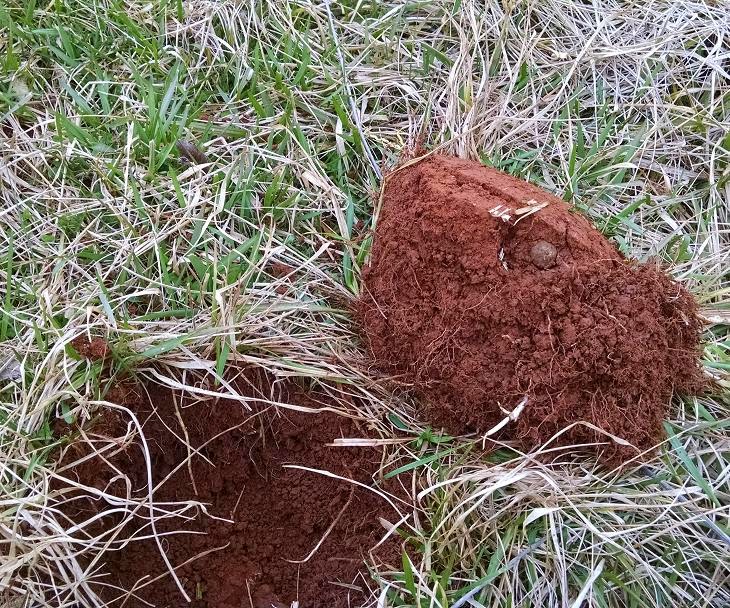
I managed to find a pit of my own right at the end of the day, but there wasn't time to explore it. So tonight I will do my best not to dream about what lies beneath. It could be nothing at all... but I imagine I will have visions of plates and bottles dancing through my head!! Wish me luck in the morning!
What really got me excited, though, was the number of brass targets I recovered as well. This included a record for me of eight general service eagle coat buttons. I also found my very first kepi hat buckle, a J hook, a cap box finial, several belt studs, and a brass thimble. The two iron objects at the top of the picture were mysteries to me, but my friend James identified them in the field as rifle parts.
While surface hunting on the hill, I watched my friend Barry get into three different fire pits. He was well rewarded for his efforts with a beautiful eagle brestplate right at the end of the day. I also got to watch Gerry, who I had just met, dig his very first Civil War bottles in a pit he located while probing in the same area.
I managed to find a pit of my own right at the end of the day, but there wasn't time to explore it. So tonight I will do my best not to dream about what lies beneath. It could be nothing at all... but I imagine I will have visions of plates and bottles dancing through my head!! Wish me luck in the morning!
Tuesday, March 24, 2015
DIV Blog - Day 3: Going DEEP with the ZED
I can honestly say I've never had a day of metal detecting quite like today. On the way back to the truck at the end of day two, I talked with Keith Leppert from Fort Bedfort detectors, and invited him back to the bullet patch for the morning of day three. I explained about finding yesterday's bullets, and how the are had been scoured with the GPX for deep bullets - a perfect testing ground for his new GPZ detector. He was down to try it out, so we hit the field running and went straight to the bullet patch.
The GPZ (I lovingly call it the Zed in honor of our Aussie friends) is meant to have greatly increased detection depth over the already impressive GPX. The area had been checked thoroughly with the GPX and stock coil, but it didn't take long for new signals to jump out from the Zed. We took our time comparing signals between machines, and carefully measuring actual bullet depths as they were recovered. All the signals were discovered with the GPZ and marked, and we took turns recovering them.

I can tell you this - the GPZ is a BEAST on deep lead! If I hadn't been there to see it, I would have trouble believing it myself. Targets at 16 - 20 inches gave a powerful response every time. I was able to hunt with the GPZ for a short time, and located two extremely deep bullets easily within a matter of minutes. We invited Russ (TDI) and Phil (GPX with SEF coil) over to check some signals as well. From our estimation, about one third of the bullets we found as we expanded out from the bullet patch into the nearby brush could have been heard as faint signals on the GPX. Another 1/3 could be heard by the GPX with the larger coils, but only with significant tweaking and knowing exactly where to swing. Under normal detecting circumstances, they would have been incredibly difficult to hear, and the stock coil missed many of these completely. The last third of the strong signals we got with the Zed wouldn't make any signal on the GPX with either coil, no matter what we tried. Needless to say, we were all somewhat dumbfounded by the power of the GPZ.

In addition to the 28 bullets I found yesterday, we recovered an astounding FORTY THREE more in the same area! We had expanded the search from a 6-8 foot circle to about 20 feet, but many of the new bullets were discovered either directly in, or within a foot or so of the original search area. My take from the bullet haul was 18 three ringers. By the end of the day we were all exhausted from digging so many deep targets, but it was some of the most fun I've had in this hobby. Many thanks to Keith, Russ, and Phil for such a great day!

And with that, the Excelsior hunt has come to a close. All of my finds from the three day hunt are shown above. I'm tired, stiff, and sore - but ready to do it again tomorrow at Brandy Rock Farm! Stay tuned!
The GPZ (I lovingly call it the Zed in honor of our Aussie friends) is meant to have greatly increased detection depth over the already impressive GPX. The area had been checked thoroughly with the GPX and stock coil, but it didn't take long for new signals to jump out from the Zed. We took our time comparing signals between machines, and carefully measuring actual bullet depths as they were recovered. All the signals were discovered with the GPZ and marked, and we took turns recovering them.
I can tell you this - the GPZ is a BEAST on deep lead! If I hadn't been there to see it, I would have trouble believing it myself. Targets at 16 - 20 inches gave a powerful response every time. I was able to hunt with the GPZ for a short time, and located two extremely deep bullets easily within a matter of minutes. We invited Russ (TDI) and Phil (GPX with SEF coil) over to check some signals as well. From our estimation, about one third of the bullets we found as we expanded out from the bullet patch into the nearby brush could have been heard as faint signals on the GPX. Another 1/3 could be heard by the GPX with the larger coils, but only with significant tweaking and knowing exactly where to swing. Under normal detecting circumstances, they would have been incredibly difficult to hear, and the stock coil missed many of these completely. The last third of the strong signals we got with the Zed wouldn't make any signal on the GPX with either coil, no matter what we tried. Needless to say, we were all somewhat dumbfounded by the power of the GPZ.
In addition to the 28 bullets I found yesterday, we recovered an astounding FORTY THREE more in the same area! We had expanded the search from a 6-8 foot circle to about 20 feet, but many of the new bullets were discovered either directly in, or within a foot or so of the original search area. My take from the bullet haul was 18 three ringers. By the end of the day we were all exhausted from digging so many deep targets, but it was some of the most fun I've had in this hobby. Many thanks to Keith, Russ, and Phil for such a great day!
And with that, the Excelsior hunt has come to a close. All of my finds from the three day hunt are shown above. I'm tired, stiff, and sore - but ready to do it again tomorrow at Brandy Rock Farm! Stay tuned!
Subscribe to:
Posts (Atom)