Showing posts with label relics. Show all posts

Monday, October 24, 2011

Cannonball Fragment Update

I was finally able to get a positive ID on the large iron piece found at the Battle of Bentonville a few days ago.  We suspected that it might be a cannonball fragment, but there was one thing that concerned me about it.  The fragment I found is obviously rounded on the outside, but the inside doesn't have the same curvature.  This is unlike most cannonball fragments I have seen in the past, which have a uniform thickness and equal curvature on the inside and out as seen in the cannonball example below.  The center would be filled with gunpowder, and a timing fuse placed in the hole would cause the cannonball to explode, sending several large pieces into the massed enemy soldiers.


In late 1862, Confederate Capt. John W. Mallet designed a new type of "internally segmented" exploding round ball which used a polygonal cavity inside the ball instead of a spherical one.  When the fuse ignited the gunpowder, the shell would fragment at the weak points in the shell wall producing a larger number of smaller fragments, which was meant to increase the damage to enemy troops.  The resulting fragments are rounded on the outside, but flat on the inside.  Each fragment will have a uniform shape determined by the geometry of the polygonal cavity, the most common being a pentagon shaped fragment.  This is the fragment I found, and a cross-section of a complete polygonal cavity shell is shown below.


The polygonal cavity cannonball was used exclusively by the Confederacy, and is fitting with the location it was found - alongside a line of fired confederate bullets at the site of a Union advance.  This type of shell was used only later in the war, and was the most commonly used Confederate cannonball in the 1865 Carolinas campaign.  Recall that the battle of Bentonville took place in March of 1865.  The complete ball measured 4.62 inches in diameter, and would have been fired from a smoothbore Napoleon 12 Pounder cannon, shown below.


With all of that history in technical terms above, it's sometimes necessary to step back from the academics and think about a recovered artifact in more personal, human terms.  It's hard to image the devastation that such a large exploding fragment could cause to the human body.  It's hard to imagine the fear of stepping out from the woodline and walking across that field, shoulder to shoulder, with rifles firing at you and shells exploding overhead.  It's hard to imagine the courage, on both sides of the battle, of risking and often losing life and limb to defend what you believe is right.  It is hard to imagine that this piece of iron which I hold in my hand was fired with the intention of taking another human life, and it is entirely possible that it was successful in doing so.  It is truly a humbling experience.

Special thanks to TheCannonballGuy over at TreasureNet for help in researching this article.

Saturday, October 22, 2011

Detecting Report: Back to Bentonville Oct 21

John, Brad, and I went back to the Battle of Bentonville to detect a few sites where John has permission to search.  We had a really great day with a lot of fun and some really cool finds.


We started off at a site we searched on our last trip down, but a different section of the field.  John started off the day with a fired Confederate Sharps bullet right out of the gate.  I called it a three-ringer in the video, but when he cleaned it up, it turned out to be a sharps.  John also got the base from a Williams cleaner bullet from this field.  I recovered two bullets there, the first being a fired and slightly deformed 58 caliber three ring Minie ball.  The second was a really nice one - a fired Confederate Enfield bullet that struck something hard straight on.  I also found a small roundball from a buck-and-ball shot, and a large piece of iron that may or may not be an artillery fragment.  You can see it much better at the end of the video, and any thoughts on that are welcomed.


What I find most interesting is not just what we found, but how those objects support our understanding of what went on in that field almost 150 years ago.  Union forces were moving in to attack the Confederates, and would have emerged from the woods and advanced across the open field.  In the open, they took Confederate fire from the opposite woodline.  This Union advance was where we were detecting yesterday, and found several fired and struck Confederate bullets.  As the Union troops moved across the middle of the field, they dropped several of their own unfired bullets, either from a pouch as they got ammunition to load or dropped by a casualty of Confederate fire.  This middle section of the field is where we detected last time, and recovered several unfired 58 three-ringers.

After lunch we went on to a second site, where John believed there may have been a small camp.  We knew it would be either feast or famine at that spot, and unfortunately we came up empty.  So we tried a third and final site that we knew would produce better, a peanut field where the plants had recently been dug up to dry.  Detecting in between the rows, we did manage some nice finds.  Brad got his bullet for the day, a fired three ringer.  John got a nice variety of finds, including a 69 round ball, a fired Confederate Enfield bullet, and an 1888 Indian Head penny.  I picked up two more dropped three ringers in this field as well. 


I also got a small lead piece there, which at the time I believed was a carved bullet.  It turns out that what I have is the finial used for closing a leather percussion cap box.  Union issued percussion cap boxes came with brass finials, but many confederates used lead finials.  I've included a picture of a confederate percussion cap box for sale at www.jsmosby.com which shows how the lead finial attached to the cap box.  I really like this find a lot!


We had a great time preserving some history, and I hope you enjoyed reading about it!  Until next time, thanks for reading, and God bless.

Sunday, October 9, 2011

A Virginia Confederate in Saxapahaw, NC

Hey everyone!  I finished up work today, and had about an hour before I could bring in and feed the horses.  So I asked my wife where I should detect around the farm, because whenever she tells me where to go I end up finding something cool.  "Well I can't now" she said "you've put me on the spot!"  But I pressed the issue, and she told me to head over towards a particular fenceline.  I had found one old coin there in the past (a no-date shield nickel), but it was mixed in with a LOT of ring-style pull tabs.  Sure enough, my hour flew by and my pouch filled with aluminum trash.

I put the detector up, brought in the horses, and passed out hay and grain.  Emily was just finishing up her lesson, and I mentioned in passing that the spot had been a bust.  "I have 15 minutes of light left" I told her "so pick another spot, and make it a good one!"

So I headed out, trying to see how many targets I could recover before the sun dipped below the trees.  The answer turned out to be just one, because what came out of the red clay stopped me in my tracks.  A two piece brass button, which I assumed was likely another Bingham Uniform button.  That's not to say Bingham buttons are common, but the close proximity to the school made it plausible.

I ran inside to clean my find, and was floored by what I saw - Civil War era Virginia State Seal button!!  The device (front image) of the button shows the figure of Virtus standing over the body of a slain tyrant, the Virginia state seal.  Above the seal reads "VIRGINIA", and below "SIC SEMPER TYRANNIS" the Virginia motto meaning "Death Always to Tyrants."  


The back of the button is even more fascinating.  The backmark reads "Kent Paine & Co. Richmond" in a depressed channel.  It was made for a unified Virginia unit prior to the outbreak of the war, but pre-war state seal buttons were, of course, used throughout the war.  The shank is bent, but still intact.  The really unique thing about this particular button is a few strands of the original attachment thread, preserved in the thick clay for all these years.  This is something I have seen on dug buttons in the past, but it is an extreme rarity.  For the collectors out there, this button is Albert's reference VA13A and Tice's reference VA222A3, and a non-dug example can be seen here: front and back.

I know that troops from both sides marched within a few miles of here in 1865, but some of my area metal detecting finds lead me to suspect at least some troops moved across my farm specifically.  This Virginia seal button is a strong piece of evidence in support of this theory.  I feel very blessed to have recovered it, especially here on my own land.  And I'm thrilled to be able to share it with all of you!  Thanks for looking, I hope you enjoyed the story, and God bless!

Thursday, September 22, 2011

Detecting Report: Saxapahaw and Mebane, Sept 22

Hey everyone!

I decided to head out today to a section of the Webb Farm at Victory Calls where I had found some older relics, but the ground has been so dry lately.  We finally got some rain yesterday and today, which really helps loosen up the clay and increase detection depth.  I only found a few new targets in the area, but one of them turned out to be this great 1844 large cent!

These larger pennies are nearly the size of a US half-dollar, and were the standard size before 1857.  They were replaced by the short-lived Flying Eagle cent (1856-1858) and the Indian Head penny (1859-1909), both the size of our smaller modern penny.  The change came as a result of complaints about the unwieldiness of the larger coins in volume, as well as increasing copper prices in the 1850's.  Increasing copper prices would again affect the penny in 1982 when the coin composition was changed to zinc with a thin copper coating.  The ground is not kind to copper coins around here, so I've also included a picture of what this coin ought to look like, courtesy of coinauctionshelp.com.

Not long after finding the cent, I got a call from some of my detecting friends, Brad and Bubba, from Mebane.  They also wanted to take advantage of the rain, so we headed off to a spot in the woods near Mebane.  This site has produced numerous Bingham School uniform buttons in the past, so that was the goal for the day.  The Bingham School was a preparatory school for boys which operated near my farm in Saxapahaw from 1844-1864, and near Mebane from 1865-1891.  I will do a much more detailed post on Bingham sometime in the future, including my uniform button collection.

Again I didn't dig many targets, but I did pull a Bingham School script-letter cuff button.  It's in absolutely TERRIBLE condition, and really I could only ID it from the construction and the filigrees on the ends of the letter "B".  That said, I was still extremely happy to have one of these rare buttons, as it is my first BS cuff button with script style lettering.
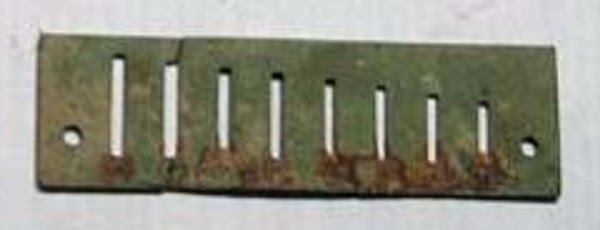
Brad was called away, so Bubba and I hit one last spot, also in the woods.  We managed to check off a few of the "most common finds" from my previous post - shotgun shells, part of a pocketwatch case, the front plate from a large lock, and even a complete harmonica reed. 

Overall, this was a fabulous day of detecting, good finds and good friends.  I'll leave you with a short video of the two best finds of the day as they come out of the ground for the first time in more than a century.  Be sure to sign up for the facebook group to stay up to date on the latest finds, history, and detecting articles.  Thanks for looking, and I hope you enjoyed! 

Tuesday, September 20, 2011

Featured Find: M1859 US Cavalry Spur, Hillsborough

This isn't my find, but it comes from my good friend Brad from Mebane.  I'm sure I'll be mentioning him in the future, as we metal detect together quite a lot.  He was detecting over in Hillsborough, NC at the kind of site I typically enjoy - not a lot of targets, but every one of them is old.  The best find for the day is this simply BEAUTIFUL model 1859 US cavalry spur.  The rowel (revolving disc) is missing from the neck, but on many dug examples the neck is broken off altogether.  The hooks for the fastening straps are bent inwards, but the yoke (body of the spur that goes around the heel) is quite straight.  The patina on this spur is simply lovely, and the characteristic M1859 foliate design around the neck shows nicely.  These spurs tend to be associated with production at the Allegheny Arsenal in Pennsylvania, and would have been issued to an enlisted cavalry soldier.  Overall, this is one of the better Civil War finds I have seen recovered in this area in recent months.

Congratulations, Brad, on the stellar find!

Sunday, September 18, 2011

So, what are you looking for, anyway?

On of the most common questions I receive while out detecting would have to be – “What are you looking for, anyway?”  Well, the answer isn’t quite as simple as the question.  I suppose the best answer would be “I don’t know yet, but I’ll know it when I see it!”  You see, not knowing what you’re going to find is a huge part of the appeal of metal detecting.  Depending on the nature of the site, there are some items which are more common to find (and others that are ubiquitous to every site).  In this post I intend to introduce you to some of the more common finds I run across.


            Buttons are common at many old sites, but their style will be different based on your location.  One of my favorite locations has given up a dozen and a half flat buttons with brazed shanks common to the 1800-1850 timeframe.  At an old school, a detecting partner of mine has collected over forty uniform buttons from 1850-1890 (I have several of these buttons as well, which I will detail in a later post).  Military uniform buttons can be found both at battle/camp sites as well as the homes of returning veterans.


            Bullets and casings are another common find, although they tend to be found most often in fields and woods where hunters frequent.  Brass shotgun headshells can be quite collectible, and a rare headstamp is always a pleasure to find.  Some of the more common older brands of shotgun shells typically found in this area are UMC Co., Rem-UMC, Peters, and Winchester.  Lead round balls can be difficult to date, but other projectiles and casing marks can be a good indicator of the age of a site.

            Many old homesites can often turn up other similar finds.  One of my favorite finds at old homes is the harmonica reed.  These are also found quite often at civil war camp sites.  Other instrument reeds, like squeezeboxes and pump organs, are also not terribly uncommon, and they are all a good indicator that you’ve found an old site.  Have you ever lost your keys?  People have been losing keys ever since they started making them, and locks and keys are relatively common finds.  A lock or a key in good excavated condition will display nicely and can have some value to collectors.
Coins are found everywhere, and sometimes in surprising places!  Two of my detecting friends accompanied me to the middle of a cattle field where we thought we might run across some civil war relics, though the site gave no indication of much human activity.  We were pleasantly surprised to find a section of the field which produced 10 coins dating from 1904-1920, including Wheat and Indian Head pennies, a Buffalo Nickel, a 1907 Liberty or V Nickel, and a 1917 Mercury dime.  Most often they are found around homes, parks, or other public gather places.  And they are usually mixed in with several decades of dropped modern copper and zinc coins.
It’s pretty easy to lose track of time, which may be why detectorists often find broken or whole pocket watches.  These are always fun to recover, though they are much more difficult to find in good shape unless they are plated in gold or silver.  Speaking of gold and silver, we do find the occasional piece of jewelry – rings, and pins being more common for me at old sites than chains, pendants, or earrings.  Many times they are simply brass or plated with gold and silver, but the occasional real gold or silver jewelry piece does turn up if you search long enough.  I’ll tell you about one of my favorite gold rings in an upcoming blog.

Buckles may not be common to lose today, but they are often found at old sites.  Not just belt buckles, but rare colonial knee and shoe buckles, 19th century suspender buckles, and much more common horse tack buckles to name a few.  Other parts of horse tack, including shoes, bridle rosettes, bits, and saddle shields can also be found at a variety of older farms and houses.

            These are just some of the items many detectorists can expect to recover from a variety of sites, but the most interesting are the ones you simply can’t predict.  The unique finds, the oddball recoveries, and the one that make you say “How the heck did this get here??”  These are the sorts of finds I will be featuring in many future blogs.  I will also be taking a more in-depth look at some of these more common finds, to discuss how they can be used to date a location and what to look for in the common finds that might make some more special than others.
 
Thanks for reading, and I hope you’ll join me again when I answer another commonly asked question about detecting, and look at some of my more unique discoveries!  In the meantime, if you have any questions, comments, or topics you would like me to address, please email me or post them to our facbook group.  See you next time!

Sincerely,
Tony Stevenson
Detecting Saxapahaw

Welcome to Detecting Saxapahaw!

Hey there, and welcome to Detecting Saxapahaw!

This blog is dedicated to preserving the history of Saxapahaw, NC and surrounding cities and towns through the documentation of research and recovered artifacts.  My name is Tony Stevenson, Saxapahaw resident since 2008.  I had used a metal detector in the past to search for coins and jewelry on beach vacations, but it never occurred to me that it could be used to foster a connection with our history.  That realization came when my wife and I purchased Victory Calls Stables three years ago.  We purchased the property with no indication of what had been there previously (the house was built in 1970), but the sheer magnitude of the massive oak trees caught my interest.  How old were they?  What might they have seen?  Who walked under the expansive canopies?

I began my search for the past at the UNC’s North Carolina Collection reading room, where the curator retrieved a large map drafted by William Luther Spoon in 1893 (there will certainly be a future blog post on the Spoon maps of Alamance County).  It didn’t take long to locate our property, with a small black rectangle indicating a home site with the name “Miss. S. A. Webb.”

My research into the Webb family, a labor of love if there ever was one, has taken countless hours of library and internet research.  A summary of my Webb family biography, as well as a sneak peak of some of the artifacts I will be detailing on this blog, can be found at the Victory Calls website.  Webb family researchers are encouraged to contact me, as I have quite a bit more information and additional pictures which are not yet published on the internet.


I don’t remember exactly when my “ah-HA!” moment came with regards to metal detecting, but not long after I began researching I realized that I could go beyond reading about these individuals and search for an even more tangible connection.  I took my trusty Garrett GTA1000 Metal detector out into the fields around VCS, and the rest (if you’ll excuse the pun) is history.  I have since been a member of both the Triangle Relic Recovery club in Raleigh and the Old North State Detectorists club from Greensboro.  In 2010, I worked alongside professionals from the North Carolina Office of State Archeology and other volunteer detectorists in a systematic survey of the Alamance Battlegrounds historical site (I recovered the musket ball in the above photo from that battle).  I have been detecting at dozens of local historical sites, including homes, fields, churches, and even one private residence on the National Register of Historic Places.  I will be telling many of the stories of my favorite spots and most interesting finds over the coming weeks and months.

Please check back to this blog as I update with information about detecting finds and the people and places that have interacted with them (both present and past).  If you would like to learn about the art of metal detecting, let me know – I’m always looking for new hunting partners.  Some of my detecting colleagues will most certainly be featured in the future as guest bloggers or interviews.

Last but certainly not least, I can’t make exciting finds without exciting locations to find them.  If you live in central North Carolina and would like me to search for your property’s history, please contact me by email (tony@victorycallsridng.com) or through the Detecting Saxapahaw facebook group!  I look forward to hearing from you.

Thanks for reading, and I hope you enjoy my work.
Sincerely,
Tony Stevenson
Detecting Saxapahaw