Sunday, March 18, 2012

DIV Blog Day 1: Bullets and a great button!

Hey everyone!  I'm sore, I'm tired, and it's only been the first day!  But I'm having a blast, and made a few cool finds.  My first find of the day came after only about 20 minutes of searching - my very first 69 caliber three ring bullet.  These things are massive!!  It's a huge piece of lead, and truly terrifying to think about as a weapon.


I took a break during the course of the day to watch several latrine pits being dug out.  I saw two complete bottles saved, both of which are simply beautiful.  I ended up with 7 bullets for the day, including two 69's, two 58's, two Sharps bullets, and one 44 Colt pistol bullet.


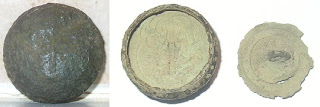
There was an hour and a half to go in the day when I ran into a friend of mine who invited me to a spot where he was digging quite a few bullets in a Confederate camp.  I was really hoping for a few more to close out the day, but I ended up with a much better find.  I could see the green rim of a button, and carefully moved the dirt to reveal a Federal ordinance officer's coat button.  Produced in the 1830's-40's, it was most likely re-purposed by the Confederacy for an artillery officer based on where it was found.

Saturday, March 17, 2012

Diggin' in Virginia Blog: Day 0

Hey everyone!  Today Josh and I made the trip up to Culpeper, Virginia for the spring Diggin' in Virginina group hunts.  We'll be here for the next 7 days, detecting a total of three Civil War sites and at least two separate battlefields.  The drive itself was uneventful, except for seeing a truck (quite unintentionally) while driving on the highway belonging to several of our friends from the Triangle Relic Recovery club from Raleigh.


After checking into the hotel, we went over to the pre-hunt meeting and show.  Several vendors were present, including Minelab with a reprise of their popular GPX detector seminar.  We were given maps of the hunt site for the first three days, the Beauregard Farm at the Battle of Brandy Station.  I'll have more to say about the battle itself later, but I simply don't have energy at the moment.

The highlight of the pre-hunt meeting, though, came shortly after I walked through the door.  We often hear DIV referred to as a "family", more than a disparate group of relic hunters, but friends who take care of their own.  This was proven to me once again when I was approached by one the DIV committee members, Earl K.  He introduced himself, and told me that he had been hunting the same hill at Hansborough Ridge (DIV XIX) where I had found my Virginia state seal tongue buckle.  The buckle had come from an officer's sword belt, and Earl had recovered two pieces of sword belt hardware from the same location.  He presented them to me, with no expectation of anything in return, to be reunited with the buckle upon returning home to North Carolina.  Earl is a stand-up guy, and an excellent example of what relic hunting and Diggin' in Virginia stands for.  Thank you so much, Earl!!


Now it's time to my gear packed up for tomorrow and try and get some sleep.  I know Josh and I are both geared up for a long day of Civil War relic hunting!!  I'll update the blog again tomorrow and let you know how we did!

Friday, March 16, 2012

Getting Ready for DIV XX and XXI

I do apologize for the lack of updates recently.  Life has gotten in the way of both detecting and blogging, and you do need to set priorities somewhere.  In any case, I've been back to the construction site once for about an hour (while I happened to be in the area) and rescued one more Williams cleaner bullet and one more three-ring minie ball.

I've been working hard to get everything in order for the next few weeks, because Detecting Saxapahaw is going back to Diggin' in Virginia!  The DIV event is a conference for relic hunters and a group hunt of known Civil War battlefields and camps near Culpeper, Virginia.  We'll have three days at the Battle of Brandy Station, one break day, and another three days of detecting at a site which currently remains a mystery.  On the break day, I'll be going to visit a friend of mine who happens to own property on the Fredericksburg battlefield, so I'll be able to do a bit of searching there too.  That's seven full days of Civil War relic hunting, the weather report looks promising (knock on wood), and I'm excited to get out there and recover some history!

You can expect daily updates over the next week as I blog about the trip and (hopefully!) some cool finds.  I leave for Virginia first thing tomorrow... I suppose I better think about packing!  Until next time, thanks for reading, and God bless!

Thursday, March 1, 2012

Detecting "Reality" Shows and the Amateur/Professional Debate

Detecting "Reality" Shows and the Amateur/Professional Debate

It seems the detecting forums and the archeological communities are in a tizzy about a pair of detecting-themed “reality” shows hitting the airwaves this year.  The first of these, entitled “Diggers”, premiered yesterday on National Geographic as a two-episode pilot trial.  The second is a full 13 episode season called “American Digger”, set to air on Spike TV and starring former professional wrestler and long-time relic hunter Ric Savage.

As much as I hate to give publicity to the debate and potentially fuel the fire, I believe it is my responsibility as a detectorist, relic hunter, and blogger to provide my opinions on the controversy to my readership.  Let me first begin by saying that most of the opinions I have seen (from amateur detectorists, relic hunters, professional archeologists, and my own) are not particularly fond of the idea of these shows.  I should also mention that I don’t have cable television, so I will be commenting on hearsay from the premier episodes of Diggers and press releases of American Digger, but I will try to focus less on specifics of these shows than on the basic premise and potential problems they present.

It would seem the majority of the debate revolves around relic hunting, and not other hobby detecting pursuits such as jewelry hunting and coinshooting.  I have yet to hear many arguments against either of these aspects of detecting, though they have been lumped in with the arguments against relic hunting in many cases.  I will limit this discussion to relic hunting in particular.


This US belt buckle from the Civil War shows extensive plow damage.  It was recovered from a field where troop movement is highly documented and recorded, but where archeological excavation would not  be logical.  Without relic hunters, it would have been destroyed in that field where it lay.


Part One:  The Skewed Reality of Detecting "Reality" Shows


There are two fundamental parts to the argument against shows like these and their portrayal of the relic hunting community.  The first is a depiction of relic hunting solely as a means of financial gain, a concept which neither professionals nor amateurs agree with.  Now don’t get me wrong, metal detecting is one of the few hobbies that can pay for its own equipment in the long run.  A man at my detecting club recently purchased Big Dawg search coil for his detector, and on his second trip the unique geometry of the coil allowed him to find a gold ring which paid for the coil.  If I were to sell my Civil War relics, I would certainly be able to pay for my equipment and then some (though I have been fortunate enough to make a few lucky finds which contribute the bulk of the worth of my collection).  Those who are in it for the money tend to be jewelry hunters, searching modern schools, parks, and beaches, not historical areas. 

But this hobby is far from profitable as a career path.  Only a very few will ever find enough to cover the cost of their equipment, batteries, fuel, and most of all the incredible amount of time required to be successful.  For each post I make showing Civil War relics I have gone out at least as many times on full day detecting trips and found nothing whatsoever.  Contrary to what these shows depict, the overwhelming majority of relic hunters I have ever met don’t do it for monetary reasons, and those who do would be quite disappointed at the typical results.  No, we relic hunters do it for the same love of history and preservation of artifacts that motivates professional archeologists.

The reality of relic hunting - far more trash than treasure. 
I personally dug everything that you see in this picture
.

Shows like Diggers and American Digger have been crafted in the same way as other successful profit-based shows like Storage Wars and American Pickers.  But in doing so, they completely misrepresent both the intentions of most relic hunters as well as the potential for profit.  Reports from the premier of Diggers show incredibly inflated values of recovered objects, and as I said, it is extremely difficult to make any money as a relic hunting hobbyist.  Sadly, this irresponsible depiction may attract new detectorists with the wrong motivations for relic hunting, delusions of quick wealth, and little training.  While I doubt that such types will stick with the hobby once they learn the reality of how difficult it actually is, I worry about the damage they may cause to our hobby in the meantime if they don’t practice ethical detecting.

Part Two:  The Impossible Idealism of the "Professionals-Only" Argument

The second argument against these shows illustrates the divide between traditional archeology and amateur enthusiasts, and is the most common argument that I have seen from those who are neither professionals nor hobby diggers.  The argument claims that relic hunting damages the integrity of historic sites, and such recoveries should only be performed by professional archeologists in every circumstance.  It isn’t simply against these shows, but the very act of relic hunting.  Those on the extreme of this viewpoint call us looters, thieves of history, and even graverobbers.  This argument is unfortunately, in large part, misinformed and counterproductive to the stated goal of preservation of our history.  Allow me to explain, but first, a caveat.

I do believe that not all sites should be available to relic hunting.  The most basic example is undisturbed pre-historic sites.  Since there is no written record of these human activities, the only information that we can gather is through painstaking archeological excavation, and this should be left to the professionals.  Furthermore, some locations in modern history are simply too engrained in our social fabric to be left to the amateurs, or are generally considered “hallowed ground” that should remain untouched by all.  Sites like Gettysburg and Monticello spring to mind.  But rather than focusing on banning metal detecting at all sites, professional archeologists need to work to preserve these sites of specific cultural importance (many of which have been purchased by the government for preservation).  I see nothing wrong with this approach whatsoever.

The argument of destruction of American cultural heritage falls apart, however, when applied to most sites which are searched by amateur relic hunters.  There aren’t enough professional archeologists, time, or money in the entire United States budget to conduct a full archeological excavation at all of this nations modern-historical sites.  Even if there were, very little new evidence would be gained by such an endeavor.  The lifestyles of 18th and 19th century America are well documented.  Civil War troop locations were well recorded (that’s how I’m able to find these sites in the first place!), and typical camp life is well understood.

The Freeman House (now Roxy Farms Antiques) in Saxapahaw, which I detected several times in 2011, was built in the late 1800's.  There are simply far too many historical sites like this one for archeologists to survey them all, and very little new information would be gained by doing so.

I often hear how important it is to examine the “strata”, or layering of depth of artifacts at a site.  But typical Civil War camp sites are often found in farmed fields, routinely plowed to depths of up to three FEET.  Strata, in such a circumstance, are meaningless.  Furthermore, we know the years and in many cases weeks or even specific days when these relics were lost thanks to the historical record.  Again, very little additional information can be obtained by a professional versus an amateur historian, even if we had unlimited resources for such professional excavations.

The idea of leaving these relics in the ground for professional recovery would be disastrous for the preservation of these items.  Many volumes of relic identification guides have been written by relic hunters based on their recoveries.  To leave these relics in the ground would be to allow them to decay to nothing, and as another relic hunter put it so eloquently, this would be nothing short of “looting by neglect.”  There is nothing more saddening to a relic hunter than excavating a Civil War era button and watching it crumble away to nothing (quite literally) upon recovery thanks to years of plow damage and heavy fertilizer use.  Contrary to popular belief, these relics won’t be around forever until an archeologist has the time and money to recover them.  They will continue to succumb to oxidation, chemical damage, physical damage from plows and bulldozers, and burial under asphalt and concrete until nothing remains.  All in the name of “preservation” from amateur relic hunters who would recover, restore, preserve, and cherish the history of these items without the luxury of a PhD and a government grant.  Pardon me if I sound a bit frustrated by that notion.

 These bullets were recovered from a construction site ready for development.  The bullets with blue circles show damage from bulldozers.  The bullet in the red circle was found on top of the ground illustrating the disturbed strata of the site.

Part 3:  The Benefits of Compromise


I mean this with no disrespect for traditional archeologists.  In fact, I believe detectorists, with all their passion for the preservation of history, are a great untapped resource for the archeological community.  I have even worked side by side with professionals from the North Carolina Office of State Archeology conducting a detector survey of the Battle of Alamance.  Together with the Old North State Detectorists club, we donated many hundreds of man hours at no cost to the state, surveying the battlefield, recording finds locations, and recovering relics for preservation.  Many of our finds are currently on display at the battlefield museum, including a rare USA button, the first and only physical evidence of a second skirmish reported to have occurred at the site later during the Revolutionary War.  The site was not a good candidate for traditional excavation (doing so would have cost much more time and money than the state could provide), and without our help that fragile pewter button would have crumbled away to nothing underground.  I have to note, however, that archeologists will never be able to tap into the potential assistance from detectorists if the rhetoric of looters and graverobbers continues.

This is me holding a musket ball from the Battle of Alamance, recovered while working with the North Carolina Office of State Archeology.

I invite the reader to peruse my site once more, and realize that many of the relics shown here would have been lost forever without amateur relic hunters like myself.  Many of the bullets presented here were recovered from a site already cleared and graded for development, soon to be covered over in asphalt.  The US buckle I recovered is nearly destroyed by constant plow damage, and would not have survived much longer in that farmed field.  The private properties where I have recovered relics with landowner permission right here in Saxapahaw would never be considered as candidates for professional archeological excavation.
This South Carolina state seal button was recovered at the Battle of Bentonville, NC.  The back is corroded and almost destroyed, while the front is barely recognizable.  The field has been plowed and turned for many years, and it common knowledge to historians that South Carolina troops were on the road where it was recovered.  There are currently no scheduled plans for archeological digs in the Bentonville area to my knowledge.  Without relic hunters, artifacts like these will be destroyed by time and the elements.

Relic hunters are not stealing history, but are showing our enthusiasm for it by preserving artifacts which would otherwise be lost.  Unfortunately, shows like “Diggers” misrepresent our goals and inflate the idea of relic hunting for profit, and do us all a disservice.  Please, do not fall into the trap of Hollywood hype, but go talk to some relic hunters for yourself.  I do believe you will find the vast majority to be as passionate and motivated about preserving history as any professional.

Sorry for the rant.  But like I said, we’re a passionate lot.

UPDATE:  I have had several requests to reprint this article.  I am offering it up under creative commons license, and you are free to repost or reprint this article in whole or in part provided you credit me as the author.

Tuesday, February 21, 2012

Saving History from Destruction

Hey everyone!  In my last post, I had gone out with Jim from Touch the Past to a camp site used by Union troops on their march through North Carolina at the end of the American Civil War.  What was once natural woods and open fields have succumbed to the steady march of "progress" to include strip malls and suburban neighborhoods.  We found a few bullets during a site survey at a large swath of development, bulldozed, graded, and ready for building.  With time limited before concrete and asphalt lock away those relics forever, we knew it was imperative to make a return trip as quickly as possible.


We spent two days this weekend hoping to save some more history, and managed to do quite well on bullets.  Day one yielded six 58 caliber Minie balls, conical bullets named for their French inventor, Claude-Etienne Minie.  Due to the earth movement at the site, one of these was found sitting directly on top of the ground!  I also recovered three Williams cleaner bullets, complete with the zinc base used to remove build up from the rifle barrel when fired.  I found one mangled round ball, several large pieces of melted lead (often referred to as "camp lead"), and two brass rivets.  The small brass wire in the same picture is part of a J hook, used on a knapsack.  It is broken in two places - the left is missing a button-like end, and the right is missing the remainder of the wire that would loop back around giving the "J" hook its name.


Day two at the site again proved to be good for bullets, yielding three more 58 caliber three-ring minies and three Williams cleaners along with some smaller camp lead.  I found a few post-war items of interest as well, pictured below.  The half-dollar sized token is an aluminum coupon for Palmolive soap, possibly from as late as the 1950's.  I noticed the top of the bottle sticking up from the ground, and carefully excavated it intact.  It reads "Syrup of Black Draught", a laxative produced since the late 1800's.  The button is iron backed, with an anchor in wreath design on the front.  Given where it was found I was really hoping for a Civil War era Federal Navy button, but it turned out to be a considerably more modern fashion button.

 
I had a great weekend getting out with Jim to save some history, and managed to have some of my best days ever with regard to bullets.  I do regret not finding this site before grading took place, as there is no telling how many more relics have been pushed and buried under feet of earth.  But on the other hand, I am proud to have saved a few more pieces of American history from being lost forever beneath the ever expanding concrete jungle.  And that, as they say, is what relic hunting is all about.

Monday, February 13, 2012

Three camps in three days

Hey everyone!  I got out this weekend to three different Civil War camps in as many days.  All three are associated with Sherman's march through North Carolina following their success at Bentonville, the surrender of the remaining Confederate forces, and the return home to the North.

The first camp I hunted on Friday with Jim from Touch the Past, and clearly illustrated the need for amateur historians like ourselves to save these relics before it is too late.  A large section of the camp had been developed into homes and strip malls long ago.  Now, stretching before us, was a large swath of cleared and graded land, slated for imminent development.  Once the concrete foundations and asphalt drives are put in place, those relics will never again see the light of day.  Even now, with the large amount of disturbance to the original topography, a great many relics have been destroyed by bulldozers or buried at unreachable depths under mountains of earth.  It was a sad sight.

We still managed to pull a few bullets from this area before moving on.  My take was one piece of camp lead and two Williams cleaner bullets.  We'll be back, but this was just meant to be a site survey and we had a second site to get to before the day was out.  Special thanks go out to Dan for turning us on to this site!!


Camp number two we discovered on January 6th, when a quick site survey turned up four shallow three-ring bullets, a large cent, and the base to a Williams cleaner bullet.  We returned to this site a second time on February 4th, and worked the site in a much slower and more methodical manner.  This yielded another four 58 caliber three ring bullets and two cleaners for me, and an equal number for Jim.  An interesting note - the cleaner top I found in February may well have come from the cleaner base I found in January!  We went back again on Friday, and really worked hard to find those small, deep signals.  Sure enough, we both pulled a pair of bullets again this time, all of them deeper.


I was also invited to detect another camp site yesterday by Glenn, Doug, and Mike from Woodland Detectors.  For the local detectorists, it's the infamous "Yankee Camp" discovered sometime last year, and pounded hard by a plethora of individuals (both invited by the original finders, as well as a few "claim jumpers", much to our chagrin).  It has yielded at least two plates in the past, along with dozens of buttons and hundreds of bullets.  Now it was hard work just to find a signal, but I did manage two 58 caliber three ring bullets that had been overlooked.  It was great to get together with the guys, and see Mike again for the first time since DIV.


So overall, it was a great weekend of relic hunting with new and old friends and a half dozen bullets thrown in for good measure.  Thanks for stopping by, and I hope you enjoyed the story and pictures!

Saturday, February 4, 2012

American Eagles and Civil War lead

Wow, I'm sorry it's been so long since my last post!  I finally have a working camera, so I'll try to get caught up on a few of my recent finds here.  In my last post I referred to an interesting buckle, which is shown here below.  It was found in an area of known Civil War activity, so I was initially pretty excited when a strong high-tone signal unearthed a large rectangular buckle.  I quickly realized it wasn't Civil War era, but it did turn out to be a unique piece of American history.  The design of this heavily silver plated belt buckle features an American eagle with shield, and scrolling banners which proclaim "Citizens Military Training Camp."


CMTC camps were operated in the period between two world wars, from 1921 to 1940.  The idea was to provide basic military training to male citizens, without the requirement of active duty service.  The month long summer camps were attended by an estimated 400,000 men during their two decade history, including Harry Truman and Ronald Reagan.  How this buckle ended up in a North Carolina farm field is anyone's guess, but it certainly is an interesting piece!


A later trip to that same area produced a different sort of military eagle - this thick convex one piece button.  I noticed when I recovered it that the heavy construction and well attached shank seemed different from the typical civilian buttons recovered at many early home sites.  It wasn't until I was cleaning my finds some days later that the eagle motif emerged.  Although heavily worn, this button is an early US artillery button, or "eagle A."  A contrast enhanced scan of the device makes the design easier to see, along with a much nicer example of what the button would look like without environmental damage.  A similar eagle was used on general service and infantry buttons, but the backmark tells us the branch of service in this case.  It was manufactured for a US artilleryman's uniform, but these early buttons were known to be pressed into service as late as the Civil War.  For you button collectors, it has Tice reference number AY199D19.


The final group of finds show the results of today's hunt with Jim from Silent Remnants.  We have been following the route of Union troops here in central North Carolina, and Jim's research brought us to an excellent patch of ground which has been largely undisturbed since Union soldiers left the area.  My bullet recoveries are shown below, including standard Union three ring bullets and two Williams cleaner bullets, both with and without the zinc base.  It was a surreal experience digging so many bullets in such a small area, and realizing that this was the exact spot in which they were dropped a century and a half ago.  And of course, what woods hunt would be complete without a healthy assortment of modern bullets and casings!


I may have more to say about this particular hunt in a future post - it really deserves a better treatment than space here allows.  Until then, I do hope you enjoyed reading and viewing some of my recent finds.  Thanks for looking, and God bless!