Sunday, November 4, 2012

Civil War relics, and a 19th Century Nickel

Hey everyone!  Here are the results from my last two trips out with my good friend Jim.  We managed to get into another pocket of relics, dropped by Union troops under General Sherman as they made their way through central North Carolina.  The first day was all about lead for me, and I recovered six 58 caliber three-ring Minie balls.  I also found the top half of another bullet, which had been cut off by a soldier, either out of boredom or to create some form of "camp art."  Jim found an ornate carved bullet nearby that was almost certainly a chess piece (perhaps a bishop or queen), and it's possible that this cut-off bullet may have been a pawn, though this is of course speculation.  It may well have been cut in half simply out of boredom, for some other purpose, or for no reason at all - we'll never know for sure.  In any case, these modified bullets have a much more personal connection to the individual soldier, and are among my favorite relics to find.


Though the number of relics was fewer on the second trip out, I'm very happy with what I was able to find.  I added one more 58 caliber bullet this time out.  The other bullet is the top half of a Williams cleaner, missing the zinc base, but is a bit more special than a typical dropped bullet.  The markings dug into the top of the bullet indicate that it was loaded into a rifle, and then subsequently pulled out again.  A corkscrew device known as a puller or worm was used to grab onto the bullet in the bottom of the barrel and pull it back out to safely unload the weapon.


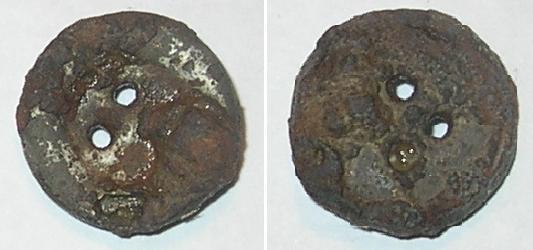
The rusty iron object is actually a four-hole underwear button, as excavated.  I have also included a picture of the button after removing much of the rust buildup  Unfortunately this is as far as I could go with cleaning it before starting to lose base metal, so I went ahead and applied a protective coat, and hopefully it won't degrade too much more.


The brass piece shown above the pulled cleaner bullet is referred to as a "J hook."  This is the first complete J hook that I have ever found, so I was very excited to recover it.  The button end was used to affix the hook to a leather strap on a knapsack, while the hook end was used as a fastener or hanger.  Below is a picture of a complete knapsack, with two brass J hooks attached.


I was very excited to dig a coin back there, hoping it was from the Civil War. Unfortunately it turns out it's post war, an 189? Liberty Head or V Nickel. While unrelated to the Civil War activity of the area, it's still a neat 100+ year old find. It must have been dropped by one of the hunters who left behind all the shotgun shell heads I keep finding out there!

Wednesday, September 26, 2012

Iron Relic Electrolysis

In my last post, I showed off a couple of cool iron relics that I recovered at the site of Mower's Charge in Bentonville, NC.  Lead and brass relics can be damaged by farm equipment, construction, fertilizer, and moisture in the ground, but are typically fairly stable once removed.  Iron relics, on the other hand, present an interesting challenge.  While they are also damaged by time underground, the rate of corrosion of iron objects rapidly increases once brought out into the atmosphere.  As a result, we have to take steps to remove the oxidation (rust) that is present upon recovery and protect the artifact from further damage.

One of the most effective methods for removing the rust layer is known as electrolysis.  Here's a picture of my electrolysis rig, and although it's a bit crude in aesthetics, the design is essentially the same as those used by universities and professional laboratories to preserve iron artifacts.  NOTE:  Electrolysis can be a very dangerous process, involving electricity with exposed wires and the generation of potentially harmful, flammable, and/or explosive gasses.  Don't try this at home.  Or if you do, be safe, use adequate ventilation, and don't say I didn't warn you.


My rig consists of a plastic container (in my case, a 5 gallon bucket) filled with an electrolyte solution (I used Cascade dish soap, primarily sodium carbonate).  In the solution are two electrodes.  For a positive electrode, I used stainless steel flashing left over from a construction job (EDIT:  I've recently learned that SS results in harmful byproducts, and should be avoided.  Use iron rebar, instead).  As you can see in the picture, I used two pieces on opposite sides of the tub to provide an even current distribution, and connected them together using four lead wires.  The negative electrode will be the iron relic to be cleaned.  In my setup, it is suspended by a crossbar using two connected wire leads.  It is very important that the two electrodes not come into contact with each other!  The positive and negative electrodes are connected to a battery charger (I used either 12V 6A or 12V 2A settings, depending on the object being cleaned).  When the current is supplied by the battery charger, the relic will start to bubble as iron oxide is stripped away, leaving a rust-free artifact.  If you're interested in learning more, I would highly recommend this video from relic hunter Beau Ouimette showing his electrolysis unit in action.


Here is a before and after showing the CS pentagonal cavity shell fragment after the first round of electrolysis.  I will most likely run it through again to remove some of the remaining stubborn rust spots, but you can already see a tremendous improvement.

A more striking example is the lock plate from an Enfield rifle found last weekend.  What was once a glob of rusted iron has been transformed to reveal the mostly-intact mechanism from inside the rifle.  The next step will be to remove excess water from the iron by soaking in acetone, and finally sealing the relic with a hot wax to prevent further rusting.


I do hope this post has been helpful (or at least entertaining).  Thanks for reading, and I look forward to showing you what I dig up next!

Monday, September 24, 2012

Detecting the Battle of Bentonville

The Battle of Bentonville, North Carolina took place on March 19-21st, 1865.  It was the last great offensive for the Confederate Army under General Joseph E. Johnston, commanding about 20,000 men.  The Union, under General William T. Sherman, was comprised of about 60,000 men.  The results of those three days of combat were more than 3,000 men killed or wounded, along with a decisive Union victory that left the Confederate army fleeing and the end of the war in sight.


On the third and final day of the battle, March 21st, General Joseph Mower requested permission to conduct “a little reconnaissance” to his front on the Union right wing.  This quickly escalated, and he lead two brigades on a full scale attack on the Confederate left wing, defending General Johnston’s headquarters as well as the highly important Mill Creek bridge.  This attack, which became known as Mower’s Charge, broke the confederate flank and reached as far as Johnston’s headquarters, forcing a Confederate retreat.  The charge was ended by a counterattack from Confederate General William Hardee (whose only son was mortally wounded during the counterattack), as well as orders from General Sherman to pull back to avoid a larger confrontation.  During the night of March 21st, the Confederates retreated across the Mill Creek bridge, ending the battle.  The drawing above is a depiction of Mower's Charge from the Frank Leslie Illustrated Newspaper.


With field crops now being to be harvested, I was able to get out with my good friend Jim to do some detecting near the site of Mower’s Charge.  I had some very good luck this trip, and broke out of my recent detecting slump in a big way.  Above is a picture of all my finds from the battle.

I recovered three bullets during the day.  The center bullet is an unfired 58 caliber three ring minie ball, the most commonly used ammunition.  To the left is another 58 caliber bullet, heavily deformed from impact after firing.  This is an excellent example of the power of the weapons used, and shows why they were capable of such devastating wounds.   On the right is another type of minie ball, this one a 577 Enfield bullet.  This is a much less common round, and only the third such bullet that I have personally recovered.


After the battle, Union Lt. Matthew Jamison of the 10th Illinois wrote “[We] form line of battle in a heavily wooded country and move forward instantly, scarcely giving time to form the line and to allow the skirmishers to deploy.  Nothing joins our extreme left – skirmishers engaged – as we advance rebel batteries shell us.”  He is describing the advance of Mower’s Charge, and the Confederate batteries (groups of typically four cannons each) firing explosive projectiles (shells) towards their approach.  One of my finds includes this heavy piece of iron, a fragment from a Confederate pentagonal cavity exploding shell.  The pentagonal internal cavity, filled with gunpowder and a particular geometry used exclusively by late-war Confederate artillery, allowed for more consistent fragmentation upon detonation and thus greater damage to enemy troops below.  I have discussed this type of projectile previously, this being the second pentagonal cavity shell fragment I have found near Mower’s charge.

My favorite find the day, though, is this rusted iron piece – a lock plate from a rifle broken or lost during the battle.  It is most likely from an Enfield rifle, although several other less common rifles used similar locks.  The hammer on the outside (which would strike the percussion cap to fire the weapon) is missing, but the internal mechanism seems to be quite intact.  Below are pictures of an original Enfield rifle showing how the lock plate attached to the gun, along with a reproduction lock plate showing the internal mechanism.  I will clean and preserve the iron by electrolysis to prevent further corrosion, and will post new pictures of the results when that is complete.

It is difficult to comprehend the circumstances of that day on March 21st, 1865 when this gun was lost.  We will never know for sure exactly why it was left there, given the incredible amount of musket fire, artillery explosions, fierce fighting, injury and death that was going on around it.  Artifacts like this always provide such a personal connection to the war that was so brutal on both sides.  That is the reason I pursue this great hobby of relic hunting, and share it with you here on Detecting Saxapahaw.


Last but not least, in case you thought it was too easy, here’s an example of some of the many pounds of junk I carted away!  Thanks for reading, and stay tuned for my upcoming electrolysis update!

Wednesday, August 8, 2012

One Man's Trash...

Hey everyone!  I've been out a few times since my last update, with a couple of keepers to show for it.  The three ring minie ball on the left was mentioned in my previous post - but since I was taking pictures of my other finds, I thought I'd include it.  The rest of the finds in this picture came from a different Union Civil War camp here in central NC.  My detecting partner Jim got the best find from this particular spot - a gorgeous "Eagle I" infantry button with original gold gilt.  I'll put up a link here when he posts a picture online.


The brass rectangles are reeds from some sort of squeezebox musical instrument, similar to the flutina reeds seen here.  They may or may not be associated with the camp, as there were some post-war era items found nearby.  The other lead finds in the picture include the top half of a William's Cleaner bullet as well as some melted lead.  I didn't notice it at first, but Jim pointed out that one of the melted lead globs is actually a half-melted bullet - you can still see the nose and conical base cavity.


I first thought that the iron bar might be a section of a bayonet blade, but I'm not quite convinced.  It has a diamond shaped cross-section, unlike the triangular cross-section associated with typical Union bayonets.  The only period bayonet with a diamond cross-section that I'm aware of is the Lorenz Austrian bayonet, used by the Confederacy.  Based on the location of the find (a late-war Union Camp), this would be unlikely, though certainly not impossible.  Opinions are welcome on this piece!


While the coin may have the look of tarnished silver, I knew from the reading on my detector that it was not.  Despite being found very near to the camp, it turned out to be a copper-nickel 1/2 Swiss Franc coin from 1979.  It's still a neat addition to my collection, though.


One of my favorite recent finds came almost completely by accident.  We were wandering about in the woods looking for another Civil War site when we stumbled across a very large bottle dump.  Trash and broken glass were strewn about everywhere, and it obviously served as a trash dump for several houses over a period of time.  My eye was drawn to this collection of partially buried milk-glass jars, and I simply had to check them out.  The bottom of one of one of these jars identifies its manufacturer as the Woodbury Soap company.  Woodbury produced a number of cosmetics products, including the cold cremes and facial cremes once found in these jars, and was incredibly popular in the 1930's and 40's.  Although not as old as most things I look for, I thought they were great, and brought them home to clean them up.  I take the old adage of "one man's trash" quite literally!!

Tuesday, July 24, 2012

Back in the Swing of Things


It seems as though things in my life might finally be slowing down enough to allow for some regular hunting.  The weather this time of year still makes detecting difficult, but I’m determined not to let that stop me!  I got together on Monday with my friend Jim to do some more Civil War detecting here in North Carolina.

We started out the day by heading over to a river crossing which our research indicated was used by a great many of Sherman’s Union troops on their way through the Old North State.  We knew what to expect of the land around the crossing from our satellite image reconnaissance – the area was simply swallowed up by the asphalt and concrete of business development.  What we were eager to check out, though, was the river itself.  Unfortunately, the water level was too high and the current too swift for any water detecting at that spot, at least right now.  Even still, it was great to walk along the water’s edge with a good friend and really soak up the history of the location.  I could almost see the soldiers attempting to cross the swift current of the creek.

Not to be dismayed, we continued on to another local spot, a Union camp site.  It was off in the woods, and the summer growth limited our search area somewhat, but there was still plenty of open area to swing.  These open areas, though, have been heavily detected in the past, and we didn’t expect much.  We each found one bullet before the heat and humidity drove us off.  Jim’s recovery was a very cool half-melted three ring minie ball, found in an area where we have recovered a great deal of melted lead in the past.  Mine was a dropped three ring minie found not far away.

I know it’s not much, but any day when I get to walk in the footsteps of our ancestors is a good one.  Finding this bullet was just icing on the cake.  I’m researching another camp site right now that has my hopes up for sure.  I’ve really got the detecting itch back again, and can’t wait to see what other cool places we can discover before fall weather re-opens many of our old sites.  Thanks for reading!

Tuesday, July 10, 2012

University of Saxapahaw TODAY!

Hey everyone!  Just a quick reminder that I'll be speaking at the University of Saxapahaw lecture series tonight at 7PM.  It's held at the Haw River Ballroom, and completely FREE.  I'll be talking about my research methods as well as local and state history, and I'm bringing lots of neat finds to show off.  For those Civil War buffs out there, I've focused part of my talk on locating Civil War relics in North Carolina, and even right here in Saxapahaw!

I'm really excited about this opportunity to speak to the community.  It should be a lot of fun, and it's free, so I hope to see you all there at the HRB tonight!

Monday, June 18, 2012

What's Up with Detecting Saxapahaw??

Hey loyal readers!!

I just wanted to fill you all in on a few things that are going on around here at Det. Sax.  First and foremost, an apology from yours truly.  I realize I haven't posted in a while, a situation I intend to rectify shortly.  The reasons for this have been many.  First off, I haven't been doing as much detecting as I would like.  This time of year can be difficult, as crops are often in plant, yards are too dry to dig, and woods are overgrown.  But I've also been focusing my efforts lately on a few personal areas of my life.  You do have to prioritize, after all.  I have gotten out a little bit, but really just exploring a few "possible" spots that didn't pan out as I would like.  I do hope to get out more regularly soon, and I'll keep you posted on the results.
Up next, I just got my invitation to the November "Diggin in Virginia" hunt.  Detecting there is by invitation only, and this will be my fourth DIV invite (one in Fall 11, and two this past spring).  This hunt will be held at Beauregard Farm, part of the Battle of Brandy Station in Culpeper, VA as well as the site winter camps from both sides during the American Civil War.  Some good friends of mine (local and distant) also received invites, and it will be great to get to go out detecting with them again.  I can't wait!!
Last but certainly not least, I hope you can join me at the July presentation of the University of Saxapahaw at the Haw River Ballroom.  U.Sax. is a monthly lecture series about a variety of topics, and next month I will be the featured speaker.  I will be presenting on my local finds, history, and research methods.  I will most likely focus on my recent passion, tracking the movement of Civil War soldiers across North Carolina and detecting those sites.  My discussion will take place July 10th at 7 PM at the ballroom in Saxapahaw, and it's completely FREE, so I do hope to see you there!

Until next time, thanks for reading Det Sax, and I will hopefully have some more exciting finds to show you all soon!