Thursday, April 4, 2013

DIV Recoveries Part 3: Oh, the Iron-y.

I'm back for the third and final post of my DIV finds series - the iron!  Most detectorists do their best to avoid digging iron at all costs.  We spend hundreds or thousands of dollars on machines to help us discriminate out the countless nails, farm tools, nails, fence wire, and nails that are omnipresent over just about every home site, field, and woods.  Did I mention we dig a lot of nails?

But there is a time and place for digging iron, and there are a lot of great iron relics out there waiting to be found.  One of my favorites finds from this trip is this iron heel plate from a soldiers boot, complete with the original nails to secure it to the heel.  The iron heel plate resembles a small horseshoe, and served the same purpose - to help keep the shoe from wearing out as quickly as the soldiers marched, often twenty or more miles per day.  While I was able to find quite a few images of original Civil War soldier's shoes online, few showed the bottom of the shoe.  However, I did find this virtual-museum image of a British military shoe from the 1850's, with the heel plate clearly visible.


The rest of my iron finds are fragments of exploded artillery shells.  I was really hoping to find a complete shell this time around, and while several were found in the area I was searching, I wasn't one of the lucky ones to get my coil over it.  I am still very happy with the fragments I recovered though.  They include two large sections of a 12lb round shell and several smaller pieces from unidentified shells.  Failing to find a full shell, the most sought after fragments are the tail section and the artillery fuze, and I was fortunate enough to recover one of each.


The base is from a Union Hotchkiss shell.  The shell was comprised of three parts, as shown in the cross section from the Ridgeway Reference Archive.  The top section contained the explosive charge to detonate the shell.  Around the middle section is a lead band, or sabot, used to grip the rifling in the cannon barrel.  This imparts a spin on the shell allowing for greater range and accuracy compared to a smooth bore cannon.  The bottom piece is an iron base cup, the section which I found.


The fuze I recovered is from a Federal 10lb Parrott shell.  The iron ring is the nose section of the shell itself, sheared off by the shell's internal explosion.  Within the iron ring is a white metal (zinc and lead) time fuze.  The hole in the center of the fuze would accommodate a paper fuze with slow-burning gunpowder lit by the flame of the propulsion charge as the shell left the cannon barrel.  The length of the paper fuze determined how much time passed before reaching the detonating charge inside the shell, causing it to explode.  I have also included a picture of a complete Parrott shell with the time fuze from the Ridgeway Reference Archive.

  
As always, thanks so much for reading Detecting Saxapahaw!  I love going out and saving tangible pieces of history, and I love being able to share it with all of you!  As always, if you have comments or questions, feel free to leave them in the comments section below or to email me at DetSax@gmail.com

Tuesday, April 2, 2013

DIV Recoveries Part 2: Brass and Pewter

Welcome back for the second installment showing my finds from the Diggin’ in Virginia XXIII Civil War relic hunt in Culpeper, VA.  In this post I’ll be talking about the brass and pewter finds from the hunt.  I didn’t find as much brass as I would like, but I’m still very happy with what I did find.


The first piece is this round brass ring, a rein guide (or terret) from a pulling horse harness.  This piece isn’t strictly a Civil War relic, as it may have been used on civilian or military cart horse harnesses, and could predate or postdate the war.  It is certainly possible, however, that it may have been used on any of the thousands of wagon-loads of ammunition, food, and supplies bound for the soldier’s camps we were detecting.  The reins used to control the horses pulling the wagon would have passed through the rein guide to keep them from becoming tangled.  I have also included a picture (thanks to CBG at Treasurenet for finding this one) of a modern horse harness showing the rein guides in use.


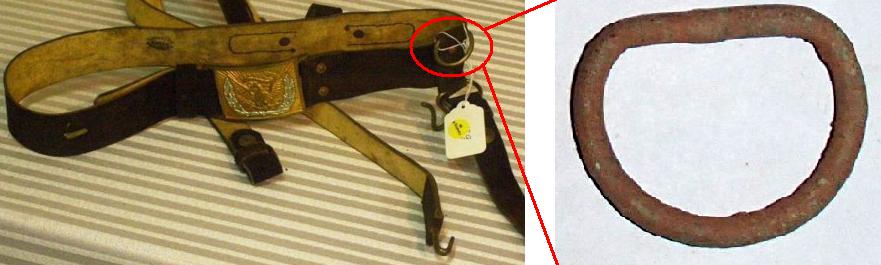
The second brass piece is a D ring from a sword belt rig.  It was found in the same Union cavalry camp where my sword belt plate was recovered last year, along with several others.  I have also included a picture of an original sword belt with D rings attached (near the price tag).

My final brass item is this great “Eagle I” infantry coat button.  The letter I in the shield denotes the branch of service – I for infantry, A for artillery, C for cavalry (or a few other less common letters like R, D, and V).  The letters were replaced with a lined shield design prior to the war for enlisted men, but the lettered buttons were still used by Union officers as well as Confederate soldiers using old button stocks during the war.


I also dug an interesting piece of pewter, which was a first for me and one of my favorite finds of the entire hunt.  It doesn’t look like much, and the condition leaves a lot to be desired, but this is a pewter spout from a canteen.  Soldiers would sometimes carve their name or initials into the spout, but deterioration from being buried for so long has eroded any letter that may have once been there.  Dug pewter can be very fragile, so this piece will be preserved to prevent further flaking.  I have also included a picture of an original M1858 canteen from the Ridgeway Reference Archive including the pewter spout.

Thanks again for reading!  Stay tuned for the next installment, the dug iron.  Trust me, it’s more exciting than it sounds.

Sunday, March 31, 2013

DIV Recoveries Part 1: Getting the lead out

Hey everyone!  I’m back from Diggin’ in Virginia XXIII, a bi-annual Civil War relic hunt.  As always, it was a blast!  I really enjoy connecting with detectorists from all over the country, seeing old friends, and making new ones.  I’d like to take a moment to give thanks to John and Rose along with the DIV committee for putting on a very professional event, John from American Digger Magazine for rooming with me, and Jeff, Dana, and Joey for the carpool and excellent company in the field.  We were blessed with great weather (excepting a few snow flurries at the end) for three full days of digging.  I saw some amazing recoveries during that time, including both Union and Confederate buckles, bullets, uniform buttons, complete artillery shells, and much more.


I’m quite pleased with my own recoveries over the course of the weekend.  I will begin with this blog post discussing my lead finds, and move on to brass, pewter, and iron in a follow-up post.  Detecting near the road I found a nice variety of different bullet types.  The most iconic and widespread bullet of the war is the three-ring minie ball.  Despite their prevalence, I only found one of these the entire weekend! I didn't photograph it for this post, but you can see numerous examples previously on the blog.


I dug two kinds of cavalry bullet, Sharps carbine and Spencer carbine.  The Sharps carbine breech-loader rifle would have originally used a paper or linen gunpowder cartridge attached to the bullet, but this has long ago deteriorated.  The Spencer repeating rifle loaded seven cartridges at a time through the buttstock of the weapon.  These cartridges were composed of a lead bullet and brass casing, although it is uncommon to recover them intact.  Shown here is a Spencer bullet with a small part of the brass casing remaining, fresh from the dirt.  I liked the look of it so much that I intent to preserve it in the original dirt as shown for future display.


Round lead bullets were in use long before the Civil War in smooth bore muskets and pistols.  Although they were eclipsed in accuracy and range by the conical Minie-ball style bullet, roundballs still saw extensive use during the war.  I found quite a few roundballs on this particular trip, from 44 to 69 caliber.


I recovered four gardner bullets which I’m particularly happy with, as I don’t tend to find many of them here in North Carolina.  These Confederate made bullets held the paper cartridge in a groove in the base of the bullet, which can be seen here.


Most of the bullets I found at DIV would be called "drops" or "dropped bullets", meaning that they have never been fired.  But I also dug these two fired bullets.  The bullet on the left obviously hit something quite hard, and is mushroomed out beyond recognition.  The bullet on the right is an Enfield bullet.  Note the ramrod mark on the nose of the bullet from where it was pushed hard into the barrel of the gun, along with the lines along the length of the bullet from where the bullet caught the rifling grooves inside the barrel as it was fired.

My favorite lead find was this highly carved Bartholow pattern pistol bullet.  The bullet was originally meant to be fired by a Colt Army revolver or similar 44 caliber pistol.  In addition to the obvious alteration around the nose of the bullet, there is also carving on the lower ring including a series of vertical lines shown here.  We may never know why a soldier took the time to create this intricately carved bullet, but many were carved as chess pieces, works of art, or simply to relieve the boredom of camp life.

That’s it for now.  Stay tuned for the next installment – my brass and pewter finds from DIV XXIII.  Thanks for reading!

Monday, March 18, 2013

A few odds and ends...

Hey there!  This post will cover a few odds and ends that I've been meaning to get to for a while now.  Up first, I have a NEW EMAIL address.  I have previously been using my work email for all correspondence, but that's gotten a bit confusing (and the storage space is rather low for large files like maps and research notes shared with my detecting friends).  So, for future correspondence about metal detecting, please use...

Next, I have a few plugs for other detecting-related media that you may be interested in.  The first is American Digger Magazine, who featured some of my recent finds in their latest issue.  The magazine includes excellent articles and pictures of finds from all facets of metal detecting.  This includes Civil War detecting (the primary focus of Detecting Saxapahaw right now) but also colonial era detecting, coin shooting, bottle digging, and more.  It's well worth checking out.  As a side note, for a more focused Civil War magazine which also includes metal detecting, check out North South Trader.  I personally recommend a subscription to both!


There are also two detecting blogs that deserve a shout-out.  Scott from Kentucky runs Detecting.us, an incredibly informative blog which discuses detecting in relation to archeology and modern technology.  Scott recently attended the Minelab Archeological Certification Program, sponsored by archeologists at James Madison's Montpelier and detectorists from Minelab Americas.  The program saw Montpelier opened up to detectorists for the first time in the site's history, working side by side with professional archeologists to search and document the site.  This is exactly the kind of collaboration that I encouraged in my previous discussion following the launch of Spike TV's train-wreck of a "detecting" show last year, and I'm glad to see such positive steps in the right direction by members of both the professional and non-professional communities.  Scott's blogging of the event is a fascinating read, and I highly recommend it!  See it here:
Part 1  Part 2  Part 3  Part 4  Part 5


I also wanted to mention a fairly new detecting blog, Allyson over at Detecting Diva.  While I do know a few female detectorists (or "detectoristas" as Allyson would say!), the hobby is admittedly very male-dominated.  It's great to see another female detectorist showcasing her talents, and I'm sure she will be an inspiration to the growing number of women in this hobby.  The blog includes detecting reports as well as links to upcoming historical presentations in the New England area.  Welcome to the world of detector-blogging!


Last but not least, I finally got out digging myself for the first time since January, and did it ever feel good to put my coil to the soil!  The day started out somewhat frustrating, as I had a list of properties to ask permission to dig, and not a single soul was at home.  Bummer!  So instead I returned to a site where I have standing permission to dig, an area of Civil War activity that had been hunted hard long before I stepped foot there.  The results were meager, but I did have a lot of fun.  I ended up with one wheat penny, a broken tack buckle, a brass rivet, and a large flat iron from a nearby homesite.  I also dug an interesting brass piece I have yet to identify, and will post on a few detecting forums to help with an ID.  Remember - never throw it away until you're sure!  I've recovered a few really nice relics from my scrap bucket in the past.

The best part of the trip came while I was detecting across the field, eyes fixated on the ground, ears tuned in to the hum in my headphones.  All of the sudden, BOOM, a loud explosion echoes through the air.  I take off my headphones, and look around and then - BOOM, BOOM, BOOM - a series of explosions.  In the distance, I see white smoke rising, and then I realized what I was hearing.  It was the sound of cannon fire from the nearby Bentonville Battlefield.  Tomorrow marks the anniversary of the 1865 battle, and this past weekend included artillery demonstrations at the Harper House visitors center.  The artillery fired several times while I was out in the field, and it was a moving experience hearing the sounds of cannon firing just as they would have been heard nearly 150 years ago.  Even though I didn't find anything that could be definitively tied to the Civil War, this was one of my most memorable trips yet.  Thanks for reading, and wish me luck next weekend when I go Diggin' in Virginia!!

Tuesday, March 12, 2013

NOT my find, but…

WOW what a piece of history.  A friend of mine recently sent me a picture of this gorgeous Tennessee-style rounded corner Confederate States belt buckle, and I just had to feature it.  It was recently recovered by Brian F. at a site right here in the Old North State.  It just goes to show – it’s still out there if you’re patient and persistent.  With all the hooks intact, the lettering clearly visible, and even some of the original belt material remaining, this is a fine example of a very rare and historical plate.  Congratulations Brian!


As for myself, work and familial obligations (combined with some crazy weather patterns) have kept me out of the fields for much too long now.  Hopefully that will change soon – this buckle find really charged me up to get back out there!


At the very least, I should have more to show in just over a week.  That’s right, it’s time once again for Diggin’ in Virginia!!  I’ve been fortunate enough to receive an invitation to attend DIV XXIII in Brandy Station, VA for three days of metal detecting battle and camp sites.  I will be running my daily blog updates again this time.  For my previous articles on Diggin' in Virginia DIV XIX, the back-to-back DIV XX and XXI, and the most recent DIV XXII).  Wish us luck!!

Tuesday, January 15, 2013

Detecting with Dad

Hey everyone!  I hope you got a chance to get out and enjoy the beautiful weather this weekend.  It's hard to believe it's still January!  Of course, I couldn't let such a nice weekend go by without a little detecting.  My parents had an opportunity to come down for a visit, so I was fortunate enough to take my dad out for some relic hunting.

I took him out to an old home site in an area with quite a bit of Civil War troop movement, and the landowner was very gracious and knowledgeable about the local history.  It was my dad's first time with a detector, so I spent the first part of the day going over the equipment, as well as proper target recovery.  I explained how to locate a signal and interpret what the detector is saying.  Once we'd found something, I showed him how to properly recover the target, cutting a plug and replacing it to keep the grass roots intact and healthy.  I have to say, he was a pretty quick learner!  It was a new site for me, so you never quite know what to expect.  Unfortunately we didn't find anything from the war between the states, but my father was happy enough digging up a few square nails and other odds and ends.  We had a nice lunch in a gorgeous pasture overlooking a pond.  I couldn't help but reminisce about the times we went out fishing when I was a boy - we never did catch anything, but they are memories I'll cherish for a lifetime.

Although the finds didn't materialize as I'd hoped, we both got out to enjoy the beautiful weather and each others company.  He enjoyed spending time with his "boy-o", and I loved showing the ropes to my "papa".  After all, when it comes down to it, it's not about the things you find.  It's about the experiences and the people you share them with.  In that regard, this weekend was a huge success.  Until next time, thanks for reading, and God bless.

Tuesday, January 1, 2013

Reflections on 2012

Hey everyone!  Happy New Year!!

I wanted to write a quick note to thank all of you, my readers, for checking out Detecting Saxapahaw over the past year.  It's been a great one, with many "firsts" and exciting experiences along the way.  Two-thousand and twelve saw me dig my first knapsack J hook (something of a quest of mine), first artillery projectiles, and quite a few new varieties of bullets including my first Gardners, Ringtail Sharps, and 69 Minies.  I got into my very first hut site, and had the pleasure to dig it out with my friend Josh at DIV XX.  And from that, I recovered my first Civil War bottle!  I managed to pull another plate this year at DIV XXI, a cavalry sword belt plate.  As far as quantity and variety of Civil War relics, this year has been my best one yet.

I've had the pleasure of exploring some exciting new locations - camps and battlefields, woods and open pasture, construction sites in urban sprawl and serene creeks in quiet forests.  I look forward to discovering many new ones in the coming months.  (Or at least having a lot of fun trying!)  I've met many unique people along the way, and heard their interesting stories of the past.  I've continued to learn more about the world around us, both present and historical.

A lot has changed in 2012, too.  Relic hunting has been a major part of me - an escape from the trials of modern life, and a way to connect with something greater than myself.  There are certainly things I would do differently in retrospect, but I have continued to grow as a person, and to learn from experiences (both good and bad).  After all, life is a process of learning, from beginning to end.  I have remained true to myself, and that is perhaps my greatest success of 2012.  I've seen new friends come and go, and my life has been enriched by the part they played in it.  Oh, and I even got a new metal detector - details on that later.

New Year's is also a time to let go of the past and look forward to our future.  I can't wait to see what 2013 has in store for all of us!  It's an exciting adventure, and I hope you'll continue to read along as I make 2013 the best year yet! 

So thank you again -
to my friends who stick by me through thick and thin
to my family who love and support me every step of the way
to my beautiful wife who is my world and my rock
to my God who has given me so much to be thankful for this past year
and to you, readers and fans, and those you hold dear.

Here's to the NEW YEAR!!