Last week I posted about
a Civil War cannonball, recently recovered by a Durham
homeowner, which was destroyed by the city's bomb squad.
I
ended by mentioning that it’s possible that what was found and destroyed wasn’t
even a cannonball at all!
This may seem like a bold claim, but there are some
discrepancies in the news stories that I will point out below to support this
hypothesis.
First, let’s talk about the probability that it is the real deal.
As regular readers of this blog probably
know, more than 100,000 soldiers fought, marched, and camped in central North Carolina at the
end of the war in 1865.
Bennett Place, the
site of the largest surrender of Confederate troops during the war, is just a few
miles from where the cannonball was found.
It’s certainly not out of the question that a cannonball could be found
in the area.
On the other hand, there
have been many millions of similar sized iron balls created in the United States
that have absolutely no relation to artillery projectiles.
The most common non-cannonball use for these
iron spheres would be
mill balls, used in a large rotating cylinder to crush
and grind material such as raw ore.
Other uses of large iron spheres include fence fixtures,
steam engine governors, shot-puts, and
crane counter-weight balls to name a few. Many even have threaded holes (such as
filled shot-puts) that can resemble fuse holes in an exploding shell.

(Left) While they bear a resemblance to solid shot cannonballs, these are steel mill balls used for grinding in cement mills. (Right) Iron balls are used in a centrifugal force governor to control the speed of a steam engine. Photo credit here.
Identifying the fuse in the cannonball would be able to identify it as ordinance
definitively.
Unfortunately, while
several articles on the Durham
cannonball
mention a
fuse, there are no images of the ball before detonation
and no mention of the recovering the fuse afterwards.
Without a fuse, the next best way to ID a cannonball would be extremely
accurate measurements of the ball’s diameter and weight.
Manufactured ordinance had to meet very exact
size standards in order to enter and be fired from the cannon’s barrel safely.
If an iron ball deviates from the
measurements in the known
ordinance shot tables, it is incredibly unlikely that
it was ever intended as a cannonball.
Once
again, though, the diameter of the Durham
ball isn’t listed in any of the articles I have seen.
Next we’ll look at the weight of the ball.
The Durham
bomb squad reported that the shell was a “6 pounder Bormann fused ball".
While the
Herald Sun reports that the name
refers to the weight of the powder charge, this is incorrect.
The “6 pound” refers to the weight of a solid
cast iron cannonball of the diameter used in that gun.
A fused cannonball is not solid, however, and
includes a hollowed out cavity filled with lead or iron balls, gunpowder, and a
packing matrix.
According to the
Ridgeway Reference Archive, a fused 6 pounder ball typically weighs between 4 and 5
pounds.
The Durham bomb squad reported that the recovered
ball weighed “about 6 pounds”, but that reported weight is inconsistent with a
cannonball with a fuse.
This could be a
misstatement by police or a misinterpretation by reporters, but without a more
accurate measurement of the cannonball’s weight prior to detonation, we can’t
use this method for ID either.

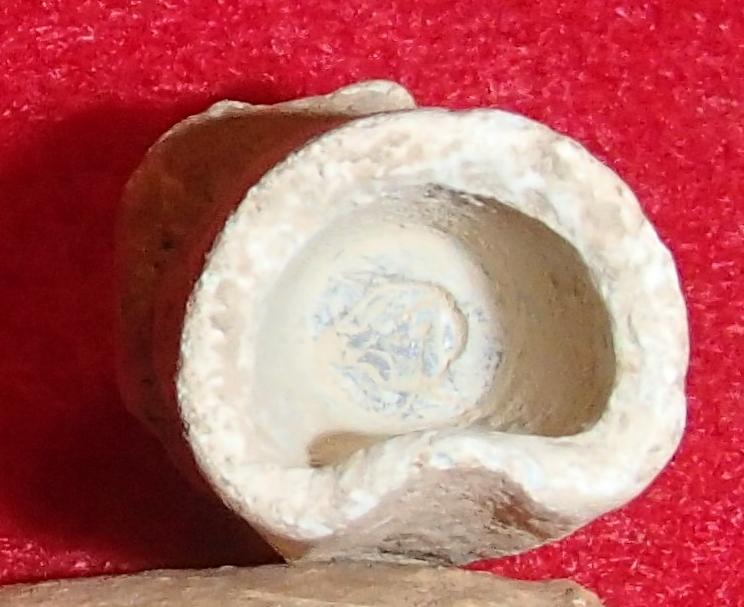
This is a cross-section of the so-called "cannonball" detonated by the Durham bomb squad last month. The photograph is from the Durham Sheriff's Department via the News and Observer.
What we do have, however, is a cross section of the ball after the controlled
detonation.
We can see here a cylindrical hole running through an otherwise solid ball.
Compare this to the cross-section of an authentic Bormann fused 6 pound
ball below.
The central “hole” in the Durham ball bears no
resemblance to the spherical powder chamber of an authentic 6 pounder
shell.
Neither opening in the Durham ball matches with
the distinct cross-section of the Bormann fuse hole.
The differences are striking. Artillery expert Peter George, who has disarmed shells for the National Parks
Service and literally
wrote the book on Civil War artillery, had
this to
say:
“Absolutely no cannonballs had a
tunnel going all the way through the iron body.”
Now this is the cross-section of a 6-pounder Bormann fused ball. Note the significant differences from Durham "cannonball" above. Photo from the Ridgeway Reference Archive.
I’m not an expert, and wouldn’t claim to be, but it appears to me that what was
presented as the Durham
“cannonball” probably isn’t. Or, at the
very least, there are a few too many discrepancies and unanswered questions for
my liking. Sadly, we will probably never
know the answer – the Durham
police didn’t return the fragments of the “cannonball” to their finder. the truth behind this mystery appears to have gone up in smoke!
Until next time, thanks for reading, and God Bless!