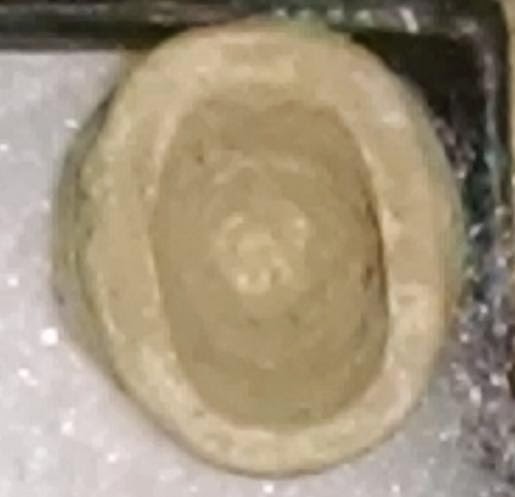
I wasn't really sure where I wanted to go on day two of the Exclesior hunt, so I asked my friend Barry (who fortuitously parked beside us) and he kindly offered to show me a spot he had been digging relics the day before. We headed off, and I got another earful of ethereal song that is the GPX. This spot, like much of the farm, had been hunted hard, but I still managed a few keepers. The first good target was an 1863 Indian Head penny, followed by a gilted eagle I cuff button and an Enfield bullet within a foot of one another. One more squished eagle I coat button rounded out the morning, and I headed back to the HQ for lunch. Along the way I got a beautiful tone right in the path to the back fields, which turned out to be pulled swage-base three ringer.
After lunch I swapped the Commander coil for the stock coil with Keith and headed back out to the field. I headed to a spot where my friend Phil was hunkered down, and we had found some relics at the last Excelsior hunt. He was finding a few things, but I wasn't having much luck until I hit on a bullet signal along the edge of the field. I dug ... and dug ... and couldn't believe how deep I found the three ring bullet in the bottom of the hole! In good detecting form, I checked my hole and realized why the machine was able to pick it up so far down - there was another target still under the earth. I quickly pulled out another three ringer, and checked the hole. Another signal.
I called over Phil, who offered to help with scanning the hole while I was detecting. Two bullets became four, and then six. Spreading out from the main target, I eventually found a total of 12 three ring Minie balls before deciding the great big hole was hunted out. I sat for a while to rest and eat (digging such a large hole at depth was hard work!), and finally strapped in to the detector to move on. No sooner had I turned on the machine then I got another deep bullet signal, just to the side of our previous excavation. Down and down and down I went again, following the trail of tones to yet more bullets. The final tally from the 6 foot or so area was a whopping 28 bullets! The deepest of them was down well past my elbow - now THAT's a deep bullet!
Chasing down these deep relics took up a good bit of the afternoon and most of my energy. While I did do some detecting afterwards, I admit I did a good bit of socializing as well. But that's part of the beauty of DIV hunts. I love being able to connect with people equally passionate (crazy?) about this great hobby.
Who knows what tomorrow has in store? Good luck, fellow diggers! See you tomorrow!
Monday, March 23, 2015
Sunday, March 22, 2015
DIV Blog - Day 1: Where's the DFX?
Day one of DIV XXIX at the New York Excelsior Camp has wrapped up, and perhaps the most common thing I heard all day was - "Hey Tony, where's the DFX?" Don't get me wrong, I do love the duct-tape wonder, and I've done pretty well with it at DIV and elsewhere over the years. But when my good friend Keith from Fort Bedford Metal Detectors gave me the opportunity to use a Minelab GPX for the hunt, I jumped on it! I've avoided using one when I've been offered to try it in the past, mostly because I didn't want to get spoiled on a new detector. Well, suffice it to say, I'm spoiled!!
I was afraid of the learning curve, but Keith and I spent the first part of the day comparing signals, and I took to it pretty quickly. The "whale songs in fast-forward" tones can be a bit overwhelming in some places, and it will be a long time before I can use one as skillfully as many of my DIV friends. But I'm very happy with the outcome for today, especially at a farm that has been hunted so hard in the past. I'll have more to say about the detector later, but for now, on to the finds so I can rest up for tomorrow.
My finds today included three-ring Minie Balls (including a cool half-melted one), a ringtail Sharps, two Williams Cleaners, a knapsack hook dug at over a foot, and several button backs and miscellaneous brass pieces. I also dug not one, but TWO wormed Gardners. The strange thing about it is that they came from opposite ends of the farm! I was already pleased with my finds at the end of the day, but I got an extra surprise when I cleaned them up at home. I knew several rare US base Minie balls have been found on this farm in the past, and today I was lucky enough to find one! That's one I've wanted to cross off the list for quite a while!
Wish us luck as we hit it again tomorrow. Until then, goodnight all!
I was afraid of the learning curve, but Keith and I spent the first part of the day comparing signals, and I took to it pretty quickly. The "whale songs in fast-forward" tones can be a bit overwhelming in some places, and it will be a long time before I can use one as skillfully as many of my DIV friends. But I'm very happy with the outcome for today, especially at a farm that has been hunted so hard in the past. I'll have more to say about the detector later, but for now, on to the finds so I can rest up for tomorrow.
My finds today included three-ring Minie Balls (including a cool half-melted one), a ringtail Sharps, two Williams Cleaners, a knapsack hook dug at over a foot, and several button backs and miscellaneous brass pieces. I also dug not one, but TWO wormed Gardners. The strange thing about it is that they came from opposite ends of the farm! I was already pleased with my finds at the end of the day, but I got an extra surprise when I cleaned them up at home. I knew several rare US base Minie balls have been found on this farm in the past, and today I was lucky enough to find one! That's one I've wanted to cross off the list for quite a while!
Wish us luck as we hit it again tomorrow. Until then, goodnight all!
Saturday, March 21, 2015
DIV Blog - Day 0: Back to the Cavalry Camp
Hi everyone! It's that time of year again - Diggin' in Virginia is upon us. For the next week I'll be out in the field with several hundred other die-hard relic hunters in the winter camps and battlegrounds around Brandy Station, Virginia. Today I took the opportunity for a pre-hunt with my friend Dustin at the Union Cavalry camp we've been searching. Once again we were not disappointed, and I ended up with a record bullet day. Most of my bullets are small caliber Colt Navy revolver rounds, which were found in one very small area. I also recovered several Smith bullets, one three ring Minie ball, one Merrill carbine bullet, part of a spur (the square looking brass piece, which would have been used to attach the spur strap), and several more shoulder scale uniform attachments. My favorite find of the day is the carved bullet in the center.
Now I'm off to get some rest before tomorrow's big dig. Wish us luck!!
Wednesday, February 11, 2015
Broken Fragments of History
Once again I can't sleep, so once again you get a nice update here at Detecting Saxapahaw! I still have a few more trips to blog about (including a great find back in early January - the suspense!), but today you'll be seeing my latest trip back to the Cavalry camp. Having already discussed a lot of the bullets that we're finding at this site, I'll be focusing this post on identifying a few fragments of history recovered out in the woods. They may not look like much, but to me, they are incredible physical reminders of those who came before us.
First up are these two small, flat, brass pieces. The bar and oval each have three attachment holes on either side. Do they look familiar? Regular readers may recall that I've blogged in the past about finding various parts of shoulder scales and their uniform attachments right here in Saxapahaw. These two pieces would have been sewn on to the uniform to attach the shoulder scale using a turnkey. The set can be reunited with the missing turnkey that I found in the same are on my last hunt!
Next, we have this small, curved piece of brass with a hole. Just a fragment of the larger piece, it really doesn't seem like much. But like the (slightly more easily identified) example from my last hunt, this is another neck from a cavalry spur. The entire brass spur would have been attached to the boot heel with a leather strap, and pressed into the horses side to direct movement. Both fragments are from different styles of roweled swan neck spurs. The iron rowel (a spinning disc with teeth attached to the neck) on the example from the last search still remains, but this one has been lost or rusted away entirely leaving only the hole where the rowel would have been.
The final fragment I'll talk about here is this brass stud. This one actually had me stumped for a while, and I wasn't entirely sure it was of the era. The location of the find certainly helped with the identification - since everything we had been finding was cavalry related, I was able to narrow my search considerably. Sure enough, this too is a small piece of a cavalry artifact - saddle bag stud. The saddle bags consisted of two bags (one for either side of the horse) connected by a leather strap. A hole in the leather strap allowed it to stay fixed to the saddle by placing it over this small stud post, which was attached to the saddle itself. The below example is from an 1859 McClellen saddle.
I'll close with the rest of my finds from another very successful day at the cavalry camp. I particularly like the hammered lead triangle and the half-melted sharps bullet. I believe the triangle was being shaped into a fishing sinker, as I have seen quite a few examples of similar sinkers made from bullets recovered from other detectorists (namely, the illustrious Beau, aka "Aquachigger"). Of course, we will never know for sure, but I am still very fond of any relic directly shaped by a soldier in the field, regardless of the intended purpose. The rest of the bullets include Sharps and Hankins (and bases of the brass casings), Sharps Carbine, and Colt (Dragoon and Army) pistol bullets.
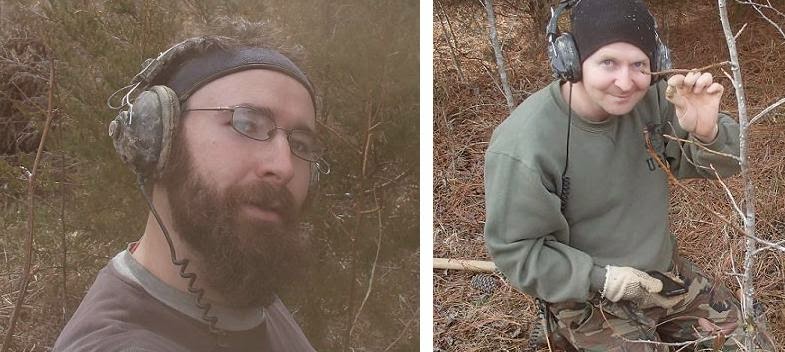
Dustin (R) and myself having a great day in the woods
First up are these two small, flat, brass pieces. The bar and oval each have three attachment holes on either side. Do they look familiar? Regular readers may recall that I've blogged in the past about finding various parts of shoulder scales and their uniform attachments right here in Saxapahaw. These two pieces would have been sewn on to the uniform to attach the shoulder scale using a turnkey. The set can be reunited with the missing turnkey that I found in the same are on my last hunt!
Next, we have this small, curved piece of brass with a hole. Just a fragment of the larger piece, it really doesn't seem like much. But like the (slightly more easily identified) example from my last hunt, this is another neck from a cavalry spur. The entire brass spur would have been attached to the boot heel with a leather strap, and pressed into the horses side to direct movement. Both fragments are from different styles of roweled swan neck spurs. The iron rowel (a spinning disc with teeth attached to the neck) on the example from the last search still remains, but this one has been lost or rusted away entirely leaving only the hole where the rowel would have been.
Saturday, January 31, 2015
Burnside and Me: Stuck in the Mud
Hi everyone! Sorry for the long delay between posts. I actually have been out detecting and handful of times since I last wrote, with a few more stories to to tell. But I'm also going through some significant personal life changes at the moment, and simply haven't had time to sit down and properly tell them. I couldn't sleep tonight, so I suppose now is as good a time as any to begin!
I will start outside of chronological order with my most recent hunt at a Yankee Cavalry camp with my friend Dustin. We have been blessed with a somewhat unseasonably warm winter this year (which aids in my ability to get out and swing), but parts of it have gone from wet to just plain soaked. The result? Detecting in a thick, soupy, mess of sticky brown mud. YUCK! I know I've come out of the woods looking somewhat akin to Swamp Thing - pants and gloves covered with the stuff, pinpointer and shovel all but camouflaged, and boots heavy with a thick layer of stuck-on mud. There were some targets I had difficulty recovering, as the holes were filling with water just as quick as I could remove it.
But of course, when I get done detecting on a wet Winter day, I have the luxury of heading home to a nice hot shower in a well insulated (and centrally heated) house. Not so the soldiers who slept in the the camp I was detecting. Those cavalrymen had no such luxury, and I don't envy the camp lifestyle. I find it interesting the number of references to the weather in the various accounts and regimental histories I read. Over and over again are mentions of the thick mud that comes with the heavy rains, and the hardships it created for the soldiers in the field.
Perhaps the most famous (but by no means the only) instance of the weather affecting the course of the war was Burnside's infamous "Mud March". In January of 1863, Union General Ambrose Burnside attempted a crossing of the Rappahanock River in an attempt to surprise the Confederates and regain the initiative in the war. Torrential downpours turned the route to an impassable, muddy mess, stalling the Union army in it's tracks. After three days, the attempt was abandoned, and Burnside was promptly replaced from command by General Joseph Hooker.
Back to my own muddy quagmire - despite the conditions on the ground, we had a very successful day recovering relics from the War. I ended up recovering a nice variety of bullets, including Sharps Carbine, Sharps and Hankins, Smith Carbine, a Merrill Carbine, a Washington Arsenal three ring Minie (the first three ringer from this camp!), and a large number of colt pistol bullets. The brass finds included the back end of a cavalry spur with iron rowel, two links from a curb chain, a belt or tack stud, an epaulette turnkey, and quite a few bases from brass Sharps and Hankins cartridges. Both Dustin and I recovered coins from the camp - mine a war-date Indian Head Penny, and his an 1817 large cent.
I will leave you with a couple of tips I've picked up for wet, cold weather detecting. Both revolve around one simple concept - it's much easier to stay warm if you can stay dry. My friend Phil taught me the first trick at the snowy Spillman Farm hunt last year - wearing a pair of latex or nitrile gloves between my regular gloves and my hands. My regular digging gloves will eventually soak through, but the latex keeps my hands underneath dry, and thus considerably warmer. Simple, but incredibly effective. The next trick involves keeping my knees dry (and again, avoiding my pants from soaking through and exposing my legs to the cold). Some folks swear by knee pads, but I find them bulky and aggravating. Instead, I simply kneel on my digging shovel when I go down to explore a hole. This keeps my pants knees off of the wet ground, keeping me warmer for longer. I don't have to carry around anything special to kneel on, and no bulky knee pads. Of course this trick won't work in manicured lawns where only a hand-digger is appropriate, but in fields or woods it works wonders to keep me going in wet winter weather.
Until next time, thanks for reading!
I will start outside of chronological order with my most recent hunt at a Yankee Cavalry camp with my friend Dustin. We have been blessed with a somewhat unseasonably warm winter this year (which aids in my ability to get out and swing), but parts of it have gone from wet to just plain soaked. The result? Detecting in a thick, soupy, mess of sticky brown mud. YUCK! I know I've come out of the woods looking somewhat akin to Swamp Thing - pants and gloves covered with the stuff, pinpointer and shovel all but camouflaged, and boots heavy with a thick layer of stuck-on mud. There were some targets I had difficulty recovering, as the holes were filling with water just as quick as I could remove it.
Me after a day of diggin' in the mud!
But of course, when I get done detecting on a wet Winter day, I have the luxury of heading home to a nice hot shower in a well insulated (and centrally heated) house. Not so the soldiers who slept in the the camp I was detecting. Those cavalrymen had no such luxury, and I don't envy the camp lifestyle. I find it interesting the number of references to the weather in the various accounts and regimental histories I read. Over and over again are mentions of the thick mud that comes with the heavy rains, and the hardships it created for the soldiers in the field.
Dragging Artillery Through the Mud, Huntsville Alabama.
Harper's Weekly, March 19, 1864
Perhaps the most famous (but by no means the only) instance of the weather affecting the course of the war was Burnside's infamous "Mud March". In January of 1863, Union General Ambrose Burnside attempted a crossing of the Rappahanock River in an attempt to surprise the Confederates and regain the initiative in the war. Torrential downpours turned the route to an impassable, muddy mess, stalling the Union army in it's tracks. After three days, the attempt was abandoned, and Burnside was promptly replaced from command by General Joseph Hooker.
My finds for the day - a good variety of bullets
Back to my own muddy quagmire - despite the conditions on the ground, we had a very successful day recovering relics from the War. I ended up recovering a nice variety of bullets, including Sharps Carbine, Sharps and Hankins, Smith Carbine, a Merrill Carbine, a Washington Arsenal three ring Minie (the first three ringer from this camp!), and a large number of colt pistol bullets. The brass finds included the back end of a cavalry spur with iron rowel, two links from a curb chain, a belt or tack stud, an epaulette turnkey, and quite a few bases from brass Sharps and Hankins cartridges. Both Dustin and I recovered coins from the camp - mine a war-date Indian Head Penny, and his an 1817 large cent.
The Indian Head penny was too corroded on the front to read a date,
but the thickness tells me it a war-date. Brass spur point and iron rowel.
I will leave you with a couple of tips I've picked up for wet, cold weather detecting. Both revolve around one simple concept - it's much easier to stay warm if you can stay dry. My friend Phil taught me the first trick at the snowy Spillman Farm hunt last year - wearing a pair of latex or nitrile gloves between my regular gloves and my hands. My regular digging gloves will eventually soak through, but the latex keeps my hands underneath dry, and thus considerably warmer. Simple, but incredibly effective. The next trick involves keeping my knees dry (and again, avoiding my pants from soaking through and exposing my legs to the cold). Some folks swear by knee pads, but I find them bulky and aggravating. Instead, I simply kneel on my digging shovel when I go down to explore a hole. This keeps my pants knees off of the wet ground, keeping me warmer for longer. I don't have to carry around anything special to kneel on, and no bulky knee pads. Of course this trick won't work in manicured lawns where only a hand-digger is appropriate, but in fields or woods it works wonders to keep me going in wet winter weather.
A simple yet effective way to stay dry and warmer in wet conditions.
Until next time, thanks for reading!
Sunday, September 7, 2014
Equipment Review: Deteknix X-Pointer
Recently I've been hearing some buzz about a new pinpointer on the market, called the X-Pointer by Deteknix. Being curious, I send an email over to my good friend Keith at Fort Bedford Metal Detectors for some input. As it turns out he had just gotten some in stock, and wanted to try them out as well, so he suggested we get together and see what they were all about. Full disclosure up front - I'm not being incentivized by Fort Bedford nor Deteknix to write this review, so you'll get the honest scoop on this product. The hype behind the X-Pointer was rather built up on the web, so it had some pretty high expectations from the start. Spoiler alert: the X-Pointer delivered.
I'll begin with the construction. It strongly resembles Garrett's ProPointer, the gold standard in the handheld pointer market. The hard plastic exterior seems robust, and should hold up well. For accessories, it comes with a fairly standard belt holster, four "tip caps" (more on these later), and a coiled lanyard. The lanyard seems like a great idea, but I didn't use it for this review, and I'll tell you why. Although the keychain rings on the lanyard are metal, the snap-clip is a pretty chintzy feeling plastic. It was the only part of the packaging that I felt appeared weak, and since I was using Keith's pinpointer, I didn't want to break it and left the lanyard at the truck. I will probably replace it with a sturdier clip at some point.
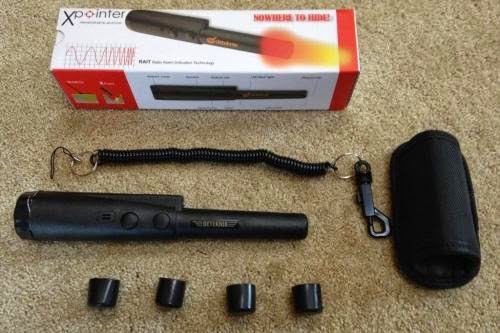
Onwards to ease of use. Detection occurs at the tip as well as up the shaft to about the X in the word Deteknix. I found it quite intuitive to change between audio/vibrate modes as well as the four tiered sensitivity settings. Although there was some decrease in detecting distance with lower sensitivity, air testing didn't show a huge difference between the various settings. It was, however, more than adequate on all settings. But enough air testing, lets talk about real world use.
We spent a day out detecting at two different sites, one with good non-mineralized soil, and the second that I would describe as moderate to high mineralization. The number one catch phrase that caught my attention about the X-Pointer was - "I can't get it to false!" And I will give that statement a qualified "true." As far as pushing, twisting, scraping the pinpointer in the hole, I absolutely could NOT get it to false. Not a chirp. Remember those tip caps I told you about? At first I thought they were a neat but unnecessary add on. After using it for a day, I can see why they were included. Since it doesn't false from pressure, you really can use the pinpointer to scratch around in the dirt with pretty good force. That's probably what most impressed me from the X-Pointer, and I really feel it's what makes this unit a step above the competition.
Now I did say that "I can't get it to false" was true to a certain point, and here's the limitation. The X-Pointer is fairly unique in that it's a pulse induction pinpointer, and that would lend one to believe that it would be unaffected by ground mineralization. I didn't find that to be the case. While the unit worked great in the neutral field on full sensitivity, the hot-ground field would still cause some falsing on just clay. The falsing was worst when more of the shaft was in contact with the dirt, rather than just the tip. I tried the "ground balancing" technique that I use with my Garrett ProPointer, and the result was the same - the falsing went away, but took with it much of the depth and sensitivity. Unlike the ProPointer, however, the X-Pointer offers another solution. I simply turned the sensitivity level down from four (max) to two in the hot-ground field, and voila! No more falsing. The depth decreased a little from the maximum setting, but not nearly the same extent as when ground balanced. So again, one more point in the X-Pointer's column.
Alright now lets get down to brass tacks. Retail price? $89.00. Compare that to the $130-ish for the Garret, and even more for the Minelab. Wow. Enough said.
To recap - Doesn't false from pressure for extreme use. Adjustable sensitivity for hot ground. Easy to use. Depth comparable to the others on the market. And a better price. The ONLY question mark remaining is the longevity, and that we'll have to wait to see. So for now, I'm sold on the X-Pointer. It would make a great addition to any detectorists arsenal, and my first recommendation for new hobbyists. Well done, Deteknix, and thank you for a great product that I look forward to using as my primary handheld unit for years to come. If you're so inclined, head on over to Fort Bedford and pick up one for yourself.
I'll begin with the construction. It strongly resembles Garrett's ProPointer, the gold standard in the handheld pointer market. The hard plastic exterior seems robust, and should hold up well. For accessories, it comes with a fairly standard belt holster, four "tip caps" (more on these later), and a coiled lanyard. The lanyard seems like a great idea, but I didn't use it for this review, and I'll tell you why. Although the keychain rings on the lanyard are metal, the snap-clip is a pretty chintzy feeling plastic. It was the only part of the packaging that I felt appeared weak, and since I was using Keith's pinpointer, I didn't want to break it and left the lanyard at the truck. I will probably replace it with a sturdier clip at some point.
We spent a day out detecting at two different sites, one with good non-mineralized soil, and the second that I would describe as moderate to high mineralization. The number one catch phrase that caught my attention about the X-Pointer was - "I can't get it to false!" And I will give that statement a qualified "true." As far as pushing, twisting, scraping the pinpointer in the hole, I absolutely could NOT get it to false. Not a chirp. Remember those tip caps I told you about? At first I thought they were a neat but unnecessary add on. After using it for a day, I can see why they were included. Since it doesn't false from pressure, you really can use the pinpointer to scratch around in the dirt with pretty good force. That's probably what most impressed me from the X-Pointer, and I really feel it's what makes this unit a step above the competition.
Now I did say that "I can't get it to false" was true to a certain point, and here's the limitation. The X-Pointer is fairly unique in that it's a pulse induction pinpointer, and that would lend one to believe that it would be unaffected by ground mineralization. I didn't find that to be the case. While the unit worked great in the neutral field on full sensitivity, the hot-ground field would still cause some falsing on just clay. The falsing was worst when more of the shaft was in contact with the dirt, rather than just the tip. I tried the "ground balancing" technique that I use with my Garrett ProPointer, and the result was the same - the falsing went away, but took with it much of the depth and sensitivity. Unlike the ProPointer, however, the X-Pointer offers another solution. I simply turned the sensitivity level down from four (max) to two in the hot-ground field, and voila! No more falsing. The depth decreased a little from the maximum setting, but not nearly the same extent as when ground balanced. So again, one more point in the X-Pointer's column.
Alright now lets get down to brass tacks. Retail price? $89.00. Compare that to the $130-ish for the Garret, and even more for the Minelab. Wow. Enough said.
To recap - Doesn't false from pressure for extreme use. Adjustable sensitivity for hot ground. Easy to use. Depth comparable to the others on the market. And a better price. The ONLY question mark remaining is the longevity, and that we'll have to wait to see. So for now, I'm sold on the X-Pointer. It would make a great addition to any detectorists arsenal, and my first recommendation for new hobbyists. Well done, Deteknix, and thank you for a great product that I look forward to using as my primary handheld unit for years to come. If you're so inclined, head on over to Fort Bedford and pick up one for yourself.
Published in American Digger Magazine - Hot Tips for Hot Dirt
Hey everyone!
As you may know, I have been a regular attendee at the bi-annual Diggin' in Virginia events for the past several years. The red clay of Culpeper, Virginia is highly mineralized, and can make detecting significantly more challenging. Pulse induction technology metal detectors have help significantly with the mineralization problem, and are the predominant machines at such hunts. Unfortunately they also have some pretty hefty price tags compared to a traditional VLF machine like my trusty White's DFX.
While I am by no means an expert, I do feel that I have been rather successful at hot-ground relic hunting with a VLF detector, thanks in large part to a few simple tricks I picked up along the way. I shared those techniques with American Digger Magazine, and the article was just released in the September-October issue (Volume 10, Issue 5). If you are interested in checking it out, you can order a subscription over at http://www.americandigger.com, or download a digital copy here.
I actually haven't gotten my copy in the mail yet, but I expect to arrive any day. If any of my readers have gotten their copy yet, drop me a line in the comments and let me know what you thought! Oh, and speaking of Diggin in Virginia.... I got my invite, so I'll have another DIV recap coming in late October. WOOHOO!
As you may know, I have been a regular attendee at the bi-annual Diggin' in Virginia events for the past several years. The red clay of Culpeper, Virginia is highly mineralized, and can make detecting significantly more challenging. Pulse induction technology metal detectors have help significantly with the mineralization problem, and are the predominant machines at such hunts. Unfortunately they also have some pretty hefty price tags compared to a traditional VLF machine like my trusty White's DFX.
I actually haven't gotten my copy in the mail yet, but I expect to arrive any day. If any of my readers have gotten their copy yet, drop me a line in the comments and let me know what you thought! Oh, and speaking of Diggin in Virginia.... I got my invite, so I'll have another DIV recap coming in late October. WOOHOO!
Subscribe to:
Posts (Atom)