Showing posts with label saxapahaw. Show all posts

Saturday, November 26, 2011

Trigger Guards: The Civil War in Bentonville and the Revolution in Saxapahaw

Yesterday was Black Friday, but instead of going out shopping, I took a trip down to Bentonville, NC with some friends to go detecting.  We tried a new field today that we just recently received permission to search.  It was the site of a Union artillery position during the three day Battle of Bentonville, March 19-21st, 1865.  You can see the results of my previous trips to Bentonville here and here.


We had hoped this field would produce, and we certainly weren't disappointed!  We recovered a lot of great history in a day, including knapsack pieces, horse tack, cartridge box finials, and of course, a number of bullets.  The find of the day was made by my good friend Jim, who recovered a great brass fuse adapter from a Union Hotchkiss artillery shell, shown above.  It's a great find, and locating at a Union artillery position during the battle made it even that much better.  Congrats, Jim!


Here are my finds for the day.  Some are the standard finds from most Civil War sites - brass grommets and rivets, unidentified period brass, and melted lead.  The two mushroomed bullets are particularly interesting, and were found in very close proximity to one another.  I also recovered my first Williams Cleaner bullet that has the base still attached.


One of the 58 caliber three-ring bullets is particularly interesting, and the first such bullet I have personally recovered.  It shows a bore hole from an "extracting worm", a corkscrew device used for pulling bullets out of the barrel of a gun.  This would have been done to remove a bullet stuck in the barrel, or to unload a loaded firearm to make it safe to handle without firing the bullet.


My best find of the day was the front half of a rifle trigger guard.  I believe it to be from a pattern 1853 Enfield rifle, based on the location of the hole used for a rifle sling attachment.  The Enfield was used by both sides during the war, and was the second most widely used infantry weapon.  An Enfield rifle from the Charelston Museum is shown below


Coincidentally, I just recovered another interesting trigger guard near Saxapahaw about a week ago.  I found it during one of my shorter hunts on Saxapahaw Bethlehem Church Rd.  It was the only good find that day, and at the time I hadn't yet identified it, so I held off on posting.  Since then I have identified it as an acorn finial from the front of a much earlier trigger guard.  Such finials were common on English fowler guns in the mid-late 1700's.  Several colonial era flat buttons have previously been found in the area, which also date to the same time period.


English fowlers were a type of smooth-bore flintlock musket.  They had very long barrels, and were designed for hunting game birds.  Now of course I can't say for certain that this particular gun was used in the American Revolution.  English fowler guns were, however, used during the war.  The British were typically issued Brown Bess flintlock muskets, though officers were meant to supply their own firearms, which have used such an acorn trigger guard as seen on English fowlers.  The Americans, on the other hand, pressed whatever weapons available into service.  A hunting rifle of this sort would certainly have been used by "citizen soldiers" going into battle.  Below is an original example of a 1770's-1780's musket, believed to have been used during the American Revolution, which bears a similar acorn motif trigger guard finial.  I can't say whether or not my trigger guard piece came from a musket used in the Revolution, but it is of the time period, and was found on muskets that were used during the war.

Tuesday, October 18, 2011

Detecting Saxapahaw: 200 Year Old Tombac Button


Hey ya'll!  Since finding an old building site with James on October 8th and detecting it with the Raleigh boys on October 15th, I just had to go back to see what else was beneath the earth!  So I went out there today to see what I could find, and came up with some neat relics to share with you.  The best of the bunch actually came from a mini-hunt when I tried to search the area yesterday evening, but the cows decided they wanted the spot and sent me packing. 


The best find is a large flat button, slightly bigger than a half dollar.  It's made of a material called "tombac", a brass alloy made with a large amount of copper and 5-20% zinc.  The result is a highly durable button which resists corrosion.  The back has a raised cone shaped base where a copper or iron shank would have been soldered on.  Tombac buttons were used for both military and civilian purposes, and were mass produced in the late 1700's.  To think, a 200+ year old button just a few inches down in a cattle field near Saxapahaw!  I love this hobby!  I know both the Morrows and the McIvers lived quite close to this field in the late 1700's, and could account for its origins.


In addition to the pictures, I also created a video of today's search.  I did something a little bit different, so I hope you like it!  Let me know what you think in the comments section below!  Thanks for looking, and God Bless!

Sunday, October 16, 2011

Detecting Report: Saxpahaw October 15th

Friday's outing was full of history and excitement, but the finds came up a bit short.  Thankfully I had a bit more luck yesterday.  I will be carpooling with three of my friends from the Triangle Relic Recovery club to the November "Diggin' in Virginia" relic hunt, so we wanted to get together for some detecting time before we go.  Dwight, Josh, and Jim drove in from the Raleigh/Durham area to detect the Webb farm and several adjoining properties.  Josh and Jim were both testing out new detectors which are meant to help with the highly mineralized Virginia soil, and while the red clay around Saxapahaw isn't quite as bad as Culpepper, it's probably the best local approximation.

We started off on the area of the Webb Farm where most of the Civil War era relics have been found.  The good news is that I was apparently quite thorough in my previous searches here.  The bad news is that even with four of us (including a TDI and a GPX4500) we had trouble finding signals.  It was still fun, though, comparing the signals we did get and finding out all the ways iron can trick your detector!


The next spot was on a cattle farm on Sax Beth Church Rd. where several other friends and I had previously stumbled upon a patch of coins ranging from 1904 to 1920.  The last ones to come out of the area had been quite deep, and almost didn't register on my DFX.  I was curious to see what the other detectors could find, and sure enough Jim's GPX was the only one to snag another coin - his very first "V" or Liberty nickel.  It's also the oldest coin of the day, produced between 1883 and 1913, but 80+ years in the ground rendered the date unreadable.

We then moved over to the spot James and I had discovered on October 8th.  There were considerably more targets in this area, and we all walked away with some misc brass.  Over the course of the day Dwight pulled a very cool pocket knife, and Josh recovered a brass bridle buckle and some other horse tack.  I dug another 19th century brass toe plate near the building spot, my second from this area.


I'm very pleased with my find of the day, though.  As I removed the dirt from within the plug of an iffy signal, I saw a small silvery disc.  Honestly, my first thought was "Dang, just a dog tag!" before I realized what it was.  It's a 1927 Standing Liberty quarter, my first ever recovered with a metal detector.  This is a coin I've been wanting to check off the list for a long time now, and I'm very happy to have found it!  I know there's more good things to find at that spot, and I'm excited to go back once we get some more rain.


Thanks again for Josh, Dwight, and Jim for coming down, I had a great time, and I hope you did too!  We'll have to get out together more often, it was a blast!

Tuesday, October 11, 2011

Local History Notes

Hey everyone!  Today's post will be a few updates for our local readers, while tomorrow I will have an article geared more towards detector enthusiasts. 

I'd first like to extend a huge CONGRATULATIONS to The Haw River Ballroom for being given the Carraway Award of Merit by Preservation North Carolina.  Heather and Tom have done an amazing job restoring the dye room at the Saxapahaw river mill into a simply gorgeous music hall and event space, while still keeping the heritage of the historic building.  This was no easy feat, but they have really done a fabulous job.  And if that isn't good enough, the blended drinks at the ballroom's coffee shop Cup 22 are top notch, so be sure to stop in and have one!  Congrats again!


I'd like to extend a special thank you to Doug Williams, a resident of Saxapahaw who has helped me researching the William P. Morrow House just outside Saxapahaw.  You'll be hearing much more about this house in future updates as I feature some of my past finds.  Doug was essential in restoring the circa 1855 house, and in the process came into possession of a book called The Book of Poetry: Illustrated with Engravings on Wood, published by the Presbyterian Board of Publications in the 1850's.  The book was inscribed by Martha A. Morrow in 1856, and research has confirmed that she was attending Edgeworth Female Seminary in Greensboro at the time.  Doug kindly allowed me to take the book to the UNC library system for preservation.  They were very interested in it, and I recently heard back that it has been accepted into the prestigious North Carolina Collection library.  The NC Collection has been instrumental in much of my research of local history, and it feels good to be a part of giving back to them.  Thank you again, Doug, for contributing to our public resource for historic preservation!


It seems like web traffic is picking up a bit, so once again I'd like to invite you all to join the Detecting Saxapahaw facebook page.  Also, don't forget that I can't find old relics without old locations - so if you own older properties in central North Carolina or know someone who does, and would like to talk about having that history featured here, feel free to email me!

Sunday, October 9, 2011

A Virginia Confederate in Saxapahaw, NC

Hey everyone!  I finished up work today, and had about an hour before I could bring in and feed the horses.  So I asked my wife where I should detect around the farm, because whenever she tells me where to go I end up finding something cool.  "Well I can't now" she said "you've put me on the spot!"  But I pressed the issue, and she told me to head over towards a particular fenceline.  I had found one old coin there in the past (a no-date shield nickel), but it was mixed in with a LOT of ring-style pull tabs.  Sure enough, my hour flew by and my pouch filled with aluminum trash.

I put the detector up, brought in the horses, and passed out hay and grain.  Emily was just finishing up her lesson, and I mentioned in passing that the spot had been a bust.  "I have 15 minutes of light left" I told her "so pick another spot, and make it a good one!"

So I headed out, trying to see how many targets I could recover before the sun dipped below the trees.  The answer turned out to be just one, because what came out of the red clay stopped me in my tracks.  A two piece brass button, which I assumed was likely another Bingham Uniform button.  That's not to say Bingham buttons are common, but the close proximity to the school made it plausible.

I ran inside to clean my find, and was floored by what I saw - Civil War era Virginia State Seal button!!  The device (front image) of the button shows the figure of Virtus standing over the body of a slain tyrant, the Virginia state seal.  Above the seal reads "VIRGINIA", and below "SIC SEMPER TYRANNIS" the Virginia motto meaning "Death Always to Tyrants."  


The back of the button is even more fascinating.  The backmark reads "Kent Paine & Co. Richmond" in a depressed channel.  It was made for a unified Virginia unit prior to the outbreak of the war, but pre-war state seal buttons were, of course, used throughout the war.  The shank is bent, but still intact.  The really unique thing about this particular button is a few strands of the original attachment thread, preserved in the thick clay for all these years.  This is something I have seen on dug buttons in the past, but it is an extreme rarity.  For the collectors out there, this button is Albert's reference VA13A and Tice's reference VA222A3, and a non-dug example can be seen here: front and back.

I know that troops from both sides marched within a few miles of here in 1865, but some of my area metal detecting finds lead me to suspect at least some troops moved across my farm specifically.  This Virginia seal button is a strong piece of evidence in support of this theory.  I feel very blessed to have recovered it, especially here on my own land.  And I'm thrilled to be able to share it with all of you!  Thanks for looking, I hope you enjoyed the story, and God bless!

Thursday, September 29, 2011

Featured Find: Can you solve the mystery of Foster’s Cafe?


Hey everyone!  Today’s featured find comes from the Webb Farm on Saxapahaw Bethlehem Church Rd. (now Victory Calls Stables), and it’s a mystery that has nagged me since I started detecting here.  It’s a small copper coin-like token, about the size of a nickel.  The back is plain, and the front read’s “Foster’s Cafe" around a letter “F” punchout.  I’ve searched, but haven’t found any reference to this token online.
Now had I just found the one token, I would probably write it off as a neat unknown find, and not give it too much more thought.  But then I found more.  Lots more.  Nearly thirty of them, all from the same farm field but spread out over several acres.  To be fair, most were found within maybe a half acre, but that’s still a sizable area.
What could they be?  It has been suggested that they were produced for the modern Foster’s Market Cafe in Chapel Hill, but I think if this were the case I would likely have found some reference to them online.  The best lead I have to go on came from the Alamance County Register of Deeds.

When the last of the Webb family, Capt. Sam Webb, died in 1929, the farm was left to his adopted son William Talbert.  William sold the property that same year to Richard Freeman Isley and his wife Vivian Foster Isley.  The land was sold in 1934 to Vivian's father, Charles Foster, owner of Foster's Hosiery Mill.  The land remained in his possession until 1947.  Could this be the “Foster” connection in “Foster’s Cafe"?
There were several periods of US history during which trade tokens saw increased usage.  These included “hard times” tokens issued during silver hoarding in the 1830’s, as well as patriotic small change tokens issued during the Civil War.  The heyday of token use in the US came from the 1870’s to early 1930’s, when a surge of small businesses in rural areas created a demand for advertising and merchandise trade tokens.  The decline of these tokens began with the Great Depression through the 1940's and 50's.  Below is an excellent example of a trade token from the Melville Drug Co. in Mebane dating to the 1920's, recovered by my friend Brad.
So it is possible that the Foster’s who owned this land from 1929-1947 were the connection to these mysterious Foster’s Cafe tokens?  Without some further evidence of either the restaurant or the tokens themselves, their origin and age will remain as mysterious as how so many became scattered across a rural Alamance County field.  But perhaps some of my readers may be able to assist – if you have any information about Foster’s Cafe of Alamance County, NC please let me know in the comments, on our facebook group, or by email.  I am in contact with a token researcher, and will keep you posted on what we find out!

Thanks for reading, and God bless!

Thursday, September 22, 2011

Detecting Report: Saxapahaw and Mebane, Sept 22

Hey everyone!

I decided to head out today to a section of the Webb Farm at Victory Calls where I had found some older relics, but the ground has been so dry lately.  We finally got some rain yesterday and today, which really helps loosen up the clay and increase detection depth.  I only found a few new targets in the area, but one of them turned out to be this great 1844 large cent!

These larger pennies are nearly the size of a US half-dollar, and were the standard size before 1857.  They were replaced by the short-lived Flying Eagle cent (1856-1858) and the Indian Head penny (1859-1909), both the size of our smaller modern penny.  The change came as a result of complaints about the unwieldiness of the larger coins in volume, as well as increasing copper prices in the 1850's.  Increasing copper prices would again affect the penny in 1982 when the coin composition was changed to zinc with a thin copper coating.  The ground is not kind to copper coins around here, so I've also included a picture of what this coin ought to look like, courtesy of coinauctionshelp.com.

Not long after finding the cent, I got a call from some of my detecting friends, Brad and Bubba, from Mebane.  They also wanted to take advantage of the rain, so we headed off to a spot in the woods near Mebane.  This site has produced numerous Bingham School uniform buttons in the past, so that was the goal for the day.  The Bingham School was a preparatory school for boys which operated near my farm in Saxapahaw from 1844-1864, and near Mebane from 1865-1891.  I will do a much more detailed post on Bingham sometime in the future, including my uniform button collection.

Again I didn't dig many targets, but I did pull a Bingham School script-letter cuff button.  It's in absolutely TERRIBLE condition, and really I could only ID it from the construction and the filigrees on the ends of the letter "B".  That said, I was still extremely happy to have one of these rare buttons, as it is my first BS cuff button with script style lettering.
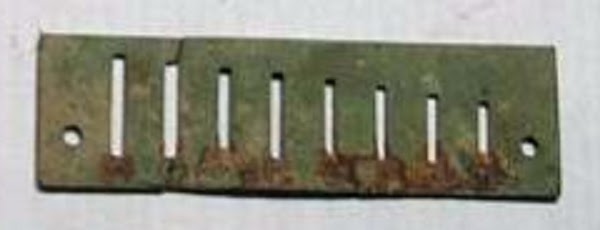
Brad was called away, so Bubba and I hit one last spot, also in the woods.  We managed to check off a few of the "most common finds" from my previous post - shotgun shells, part of a pocketwatch case, the front plate from a large lock, and even a complete harmonica reed. 

Overall, this was a fabulous day of detecting, good finds and good friends.  I'll leave you with a short video of the two best finds of the day as they come out of the ground for the first time in more than a century.  Be sure to sign up for the facebook group to stay up to date on the latest finds, history, and detecting articles.  Thanks for looking, and I hope you enjoyed! 

Wednesday, September 21, 2011

Featured Find: A pair of 3's

Hey everyone!

I received my order of new coin cases from CoinWorld.com today, including
specialty cases for two of my most unique coin finds which I’ve decided to
share with you!  Ever needed to buy a postage stamp, and wished you had a
single coin for the purchase?  No?  Me either, but that was the unique
origin of the three-cent coin.

(Photo credit PCGS CoinFacts)
The first US three-cent coin was produced in 1851 as a result of the change
of the postage rate to three cents, and the need for more
small-denominational coins.  The three-cent silver (sometimes called a
“trime”) was the lightest of all US coins, and smallest diameter non-gold
US coin.  Original composition of the coin was 75% silver to discourage
melting for bullion (a fairly common practice recently with modern silver
coins due to high silver prices).  It was increased to 90% silver in 1854
to encourage greater circulation.  Silver three-cent coins were produced
from 1851-1873 with a total mintage of 42.7M.
(Photo credit PCGS CoinFacts)
Economic conditions during the Civil War lead to widespread hoarding of
gold and silver coins.  One of the government’s responses was to issue a
nickel-copper three-cent coin in 1865.  Intended only as a stopgap measure
until hoarding ended, nickel three-cent coins were produced from 1865 to
1889 with a total mintage of 31.3M with more than 75% of those produced
prior to 1870.
My first three-cent coin was an 1853 silver from Victory Calls (the old
Webb Farm) on Saxapahaw Bethlehem Church Rd. in February.  This month I
was lucky enough to find the nickel three-cent at another historic farm on
the same road!   From a detecting standpoint, these are very rare coins
indeed, for a variety of reasons.  First, both have very low mintage
compared to many other coins (compare: 245M seated dimes, 500M barber
dimes, 1800M quarters in 1965 alone).

Both three-cent coins also have other limitations that make them
particularly difficult to detect.  For the silver trime, the problem is
one of size.  Being both smaller than a dime and considerably thinner,
they can be very difficult for a detector to pick up.  Even more difficult
to recover is the three-cent nickel, not due to size (it is the same size
as a US dime) but metal composition.  Silver is a high conductivity
material, and gives a signal on the high end of the scale where not many
trash targets appear (White’s VDI #’s 70-95).  The copper-nickel alloy, on
the other hand, appears very low on the scale where it can mimic many
other materials and trash targets.  (This is one reason many detectorists
find so many more pennies/dimes/quarters than nickels).  Being smaller
than a US nickel, the three-cent nickel shows up even lower at the bottom
of the scale (White’s VDI #’s 13-16).  In a trashy location with many
targets, this coin would be extremely easy to miss.  I feel incredibly blessed 
to have found both types of this very rarely recovered coin.

And so, without further ado, my new coin cases:

Sunday, September 18, 2011

So, what are you looking for, anyway?

On of the most common questions I receive while out detecting would have to be – “What are you looking for, anyway?”  Well, the answer isn’t quite as simple as the question.  I suppose the best answer would be “I don’t know yet, but I’ll know it when I see it!”  You see, not knowing what you’re going to find is a huge part of the appeal of metal detecting.  Depending on the nature of the site, there are some items which are more common to find (and others that are ubiquitous to every site).  In this post I intend to introduce you to some of the more common finds I run across.


            Buttons are common at many old sites, but their style will be different based on your location.  One of my favorite locations has given up a dozen and a half flat buttons with brazed shanks common to the 1800-1850 timeframe.  At an old school, a detecting partner of mine has collected over forty uniform buttons from 1850-1890 (I have several of these buttons as well, which I will detail in a later post).  Military uniform buttons can be found both at battle/camp sites as well as the homes of returning veterans.


            Bullets and casings are another common find, although they tend to be found most often in fields and woods where hunters frequent.  Brass shotgun headshells can be quite collectible, and a rare headstamp is always a pleasure to find.  Some of the more common older brands of shotgun shells typically found in this area are UMC Co., Rem-UMC, Peters, and Winchester.  Lead round balls can be difficult to date, but other projectiles and casing marks can be a good indicator of the age of a site.

            Many old homesites can often turn up other similar finds.  One of my favorite finds at old homes is the harmonica reed.  These are also found quite often at civil war camp sites.  Other instrument reeds, like squeezeboxes and pump organs, are also not terribly uncommon, and they are all a good indicator that you’ve found an old site.  Have you ever lost your keys?  People have been losing keys ever since they started making them, and locks and keys are relatively common finds.  A lock or a key in good excavated condition will display nicely and can have some value to collectors.
Coins are found everywhere, and sometimes in surprising places!  Two of my detecting friends accompanied me to the middle of a cattle field where we thought we might run across some civil war relics, though the site gave no indication of much human activity.  We were pleasantly surprised to find a section of the field which produced 10 coins dating from 1904-1920, including Wheat and Indian Head pennies, a Buffalo Nickel, a 1907 Liberty or V Nickel, and a 1917 Mercury dime.  Most often they are found around homes, parks, or other public gather places.  And they are usually mixed in with several decades of dropped modern copper and zinc coins.
It’s pretty easy to lose track of time, which may be why detectorists often find broken or whole pocket watches.  These are always fun to recover, though they are much more difficult to find in good shape unless they are plated in gold or silver.  Speaking of gold and silver, we do find the occasional piece of jewelry – rings, and pins being more common for me at old sites than chains, pendants, or earrings.  Many times they are simply brass or plated with gold and silver, but the occasional real gold or silver jewelry piece does turn up if you search long enough.  I’ll tell you about one of my favorite gold rings in an upcoming blog.

Buckles may not be common to lose today, but they are often found at old sites.  Not just belt buckles, but rare colonial knee and shoe buckles, 19th century suspender buckles, and much more common horse tack buckles to name a few.  Other parts of horse tack, including shoes, bridle rosettes, bits, and saddle shields can also be found at a variety of older farms and houses.

            These are just some of the items many detectorists can expect to recover from a variety of sites, but the most interesting are the ones you simply can’t predict.  The unique finds, the oddball recoveries, and the one that make you say “How the heck did this get here??”  These are the sorts of finds I will be featuring in many future blogs.  I will also be taking a more in-depth look at some of these more common finds, to discuss how they can be used to date a location and what to look for in the common finds that might make some more special than others.
 
Thanks for reading, and I hope you’ll join me again when I answer another commonly asked question about detecting, and look at some of my more unique discoveries!  In the meantime, if you have any questions, comments, or topics you would like me to address, please email me or post them to our facbook group.  See you next time!

Sincerely,
Tony Stevenson
Detecting Saxapahaw

Welcome to Detecting Saxapahaw!

Hey there, and welcome to Detecting Saxapahaw!

This blog is dedicated to preserving the history of Saxapahaw, NC and surrounding cities and towns through the documentation of research and recovered artifacts.  My name is Tony Stevenson, Saxapahaw resident since 2008.  I had used a metal detector in the past to search for coins and jewelry on beach vacations, but it never occurred to me that it could be used to foster a connection with our history.  That realization came when my wife and I purchased Victory Calls Stables three years ago.  We purchased the property with no indication of what had been there previously (the house was built in 1970), but the sheer magnitude of the massive oak trees caught my interest.  How old were they?  What might they have seen?  Who walked under the expansive canopies?

I began my search for the past at the UNC’s North Carolina Collection reading room, where the curator retrieved a large map drafted by William Luther Spoon in 1893 (there will certainly be a future blog post on the Spoon maps of Alamance County).  It didn’t take long to locate our property, with a small black rectangle indicating a home site with the name “Miss. S. A. Webb.”

My research into the Webb family, a labor of love if there ever was one, has taken countless hours of library and internet research.  A summary of my Webb family biography, as well as a sneak peak of some of the artifacts I will be detailing on this blog, can be found at the Victory Calls website.  Webb family researchers are encouraged to contact me, as I have quite a bit more information and additional pictures which are not yet published on the internet.


I don’t remember exactly when my “ah-HA!” moment came with regards to metal detecting, but not long after I began researching I realized that I could go beyond reading about these individuals and search for an even more tangible connection.  I took my trusty Garrett GTA1000 Metal detector out into the fields around VCS, and the rest (if you’ll excuse the pun) is history.  I have since been a member of both the Triangle Relic Recovery club in Raleigh and the Old North State Detectorists club from Greensboro.  In 2010, I worked alongside professionals from the North Carolina Office of State Archeology and other volunteer detectorists in a systematic survey of the Alamance Battlegrounds historical site (I recovered the musket ball in the above photo from that battle).  I have been detecting at dozens of local historical sites, including homes, fields, churches, and even one private residence on the National Register of Historic Places.  I will be telling many of the stories of my favorite spots and most interesting finds over the coming weeks and months.

Please check back to this blog as I update with information about detecting finds and the people and places that have interacted with them (both present and past).  If you would like to learn about the art of metal detecting, let me know – I’m always looking for new hunting partners.  Some of my detecting colleagues will most certainly be featured in the future as guest bloggers or interviews.

Last but certainly not least, I can’t make exciting finds without exciting locations to find them.  If you live in central North Carolina and would like me to search for your property’s history, please contact me by email (tony@victorycallsridng.com) or through the Detecting Saxapahaw facebook group!  I look forward to hearing from you.

Thanks for reading, and I hope you enjoy my work.
Sincerely,
Tony Stevenson
Detecting Saxapahaw